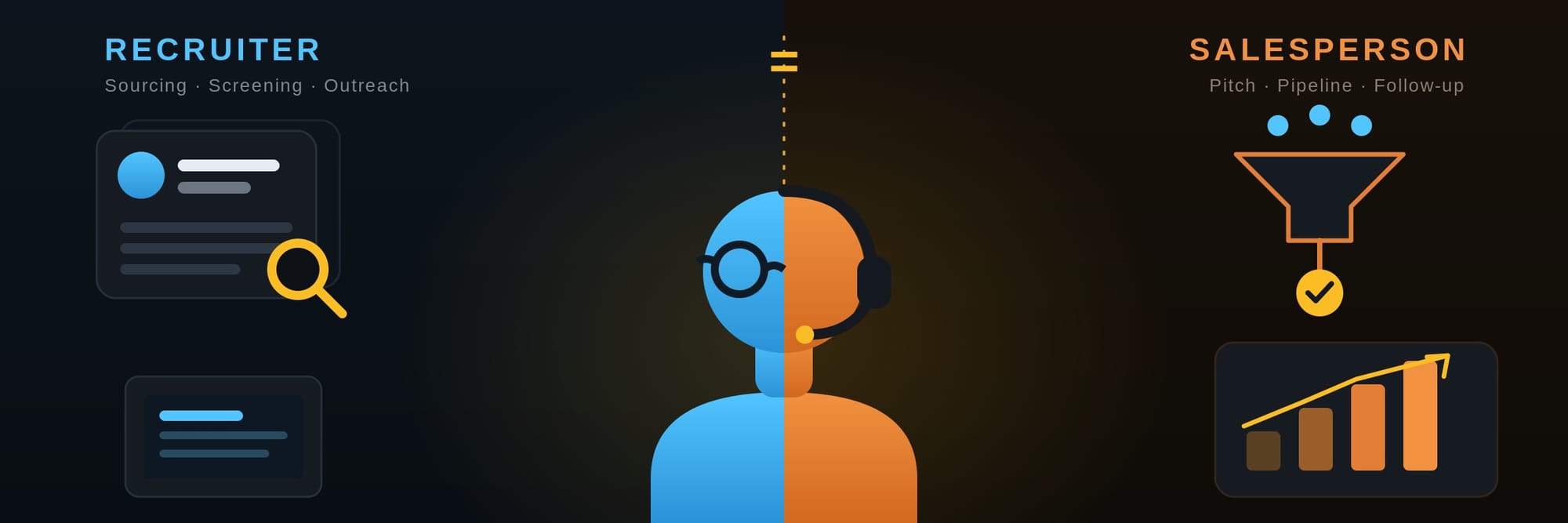
The founding recruiter is the second salesperson at your startup
When you recruit for Open AI or Anthropic or other well known companies, the job is mostly evaluation. The applications come in. Thousands of them. The brand did the selling before you ever opened the inbox.
When you recruit for a 5-person startup nobody has heard of, none of that is true. You don't have a pile to filter. You have an empty pipeline and a name candidates have to Google. Evaluation is maybe 20% of the job. The other 80% is sales and marketing, and most people don't realize that until they're three weeks into a search with two replies.
This is the part of startup recruiting nobody warns you about. So let me break down what the job actually is.
Screening is only a part of the job, convincing talent to join is another big part.
At a known company, the candidate is selling themselves to you. At a startup, you're selling to them first. The best engineer you want already has a job, three recruiters in her inbox this week, and zero reason to take a meeting with a company she can't find on Crunchbase.
So the founding recruiter has to do what a salesperson does. Find the right people. Write a message that earns a reply. Make a stranger care about a thing they've never heard of. It is the art of sales.
And the CEO is not the only one who has to pitch the company. Founders love to say "I'll close any candidate, just get them in front of me." Sure. But you can't get them in front of the founder if your first cold email reads like every other cold email. The selling starts way before the founder ever joins the call. It starts with you.
Standard job posts won’t cut it. Good content is needed.
Here's where it gets uncomfortable for a lot of recruiters. The traditional job post, the bulleted "responsibilities and requirements" wall of text, is invisible. Nobody good is reading it. It competes with ten thousand identical posts and loses.
What works looks a lot more like marketing. A short, specific story about why this role exists and what the person will actually build. A founder's voice instead of an HR template. A reason to care that isn't "competitive salary and equity."
So the founding recruiter becomes a content person whether they signed up for it or not. You're writing. You're picking channels: where does this kind of candidate actually hang out, X, a niche Slack, a Discord, a specific subreddit, a conference. You're testing which message lands. The job stopped being "post and pray" a long time ago.
The boring part that decides everything: deliverability
This is the most undervalued skill in startup recruiting and it's lifted straight from sales.
You can write the best outreach in the world. If it lands in spam, it doesn't exist. Cold sending from a brand-new domain with a blast of 200 emails on day one is how you get your domain flagged and your reply rate goes to zero, and you don't even know why because the emails "sent fine."
So you do what every good sales team does. You warm up the domain before you scale sending. You keep volume sane. You watch your sender reputation. You make sure the email actually reaches a human inbox before you worry about whether the human says yes.
Most recruiters have never thought about this once. The ones who close hard roles think about it constantly.
A/B test like a marketer, because you are one
Different roles need different pitches. What gets a senior backend engineer to reply is not what gets a first marketing hire to reply. The engineer wants the technical problem and the team. The marketer wants the ownership and the stage.
So you test. Two subject lines. Two openers. A version that leads with the mission and a version that leads with the problem. You look at which one gets opens, which gets replies, which gets replies that turn into calls. Then you do more of what works. This is conversion optimization. We just don't call it that in recruiting.
Then the candidate says yes, and the real grind starts
Say all of that works. You sourced, you wrote, your email landed, they replied, they're interested. Now they're in your pipeline.
At an early-stage startup, there is no recruiting coordinator. There's you. Every admin task that a 200-person company has a whole team for now lives on your plate. Scheduling the interview. Chasing the hiring manager for feedback that was due three days ago. Making sure the candidate from two weeks ago didn't quietly fall through the cracks because everyone got busy shipping.
This is where good pipelines die. Not because the candidate wasn't good enough. Because someone forgot to follow up. The candidate took another offer while your team was "getting to it."
In sales, the follow-up is the whole game. The deal isn't lost when they say no. It's lost when you go quiet and they forget you exist. Recruiting is identical. The candidate you ghosted for a week is a candidate you've already half-lost, and they'll remember it.
Why I have so much respect for the people doing this
The founding recruiter or whoever taking on the recruiting job at a startup is running a full go-to-market motion. Sourcing is prospecting. Outreach is sales development. The pitch is positioning. The pipeline is a sales pipeline with feelings. And they're doing all of it for a company that can't compete on brand or comp, against companies that can.
That's hard. It's underrated. And it's most of why we're building Chosen HQ.
We built it for the person doing this job with no coordinator, no enterprise tooling, and no time. Candidate matched and highlighted so you're not re-reading the same resume at 11pm. AI coordinate the interviews so that you don't have to chase for available times. One dashboard so nobody falls out of the pipeline because you lost track of who's where. The selling, the relationship building, the personal touch, those are yours and they should be. The dropped follow-ups and the manual pipeline babysitting shouldn't be.
If you're the one quietly carrying recruiting at a startup right now, you already know this is sales. Come build your pipeline somewhere that treats it that way.