Can you do agency recruiting without the sales part?
Yes, on a marketplace where the client is already signed; selling is about half a full desk's week, and giving it up costs 20% of the fee rather than half.
Yes. Search-only desks have always existed; what changed is the price of one. An agency delivery seat keeps 30 to 50% of the fee, because the agency owns the client. When a marketplace owns the client its share can be 20%, and on a $170,000 placement at a 20% fee a recruiter who never made a sales call keeps $27,200.
Agency-style recruiting without the sales part
Agency-style recruiting has two halves. The delivery half is the craft: the brief, the sourcing, the screens, the packet, the close. The sales half is everything that produces the job order and keeps it: prospecting, the pitch, the fee negotiation, the terms, the weekly client call, and re-selling the search after a candidate falls through. The question is whether you can keep the first half and hand off the second.
Three arrangements do that. Inside an agency it is a 180 seat: in Pin's explainer on 360 recruitment, a 180 recruiter works only the candidate side of the desk and a separate team wins the clients. In a split network the recruiter who owns the order shares the fee with the one who fills it. On a marketplace the company signs with the platform and posts the role with the fee set, and you apply to work it.
Each is a real search-only desk. They differ in who owns the client, and that decides what you keep.
Not selling used to cost half the fee, and now it costs a fifth
The consensus in the trade is that a recruiter who cannot sell is half a recruiter, and that the only search-only desks are junior seats at a fraction of the fee. Agency owners say it, and the pay structure agrees with them. Glozo's write-up on recruiter salaries puts an agency recruiter's cut at typically 30 to 50% of what the agency collects from the client, on top of a base of $50,000 to 90,000.
That price was set by who owned the client, and until recently the only people who owned clients were the people who had sold them, so the trade priced the selling and the ownership as one thing. When the platform owns the client, the price of not selling drops to whatever the platform keeps, and that can be 20%.
Here is the worked example for this post. A $170,000 base at a 20% fee is $34,000. On an agency desk at a 35% split, inside Glozo's 30 to 50% range, the recruiter keeps $11,900 and the agency keeps $22,100. On a marketplace at an 80% share, the recruiter keeps $27,200 and the platform keeps $6,800. With their own client the recruiter keeps all $34,000 and did the selling. The search was the same work on all three desks.
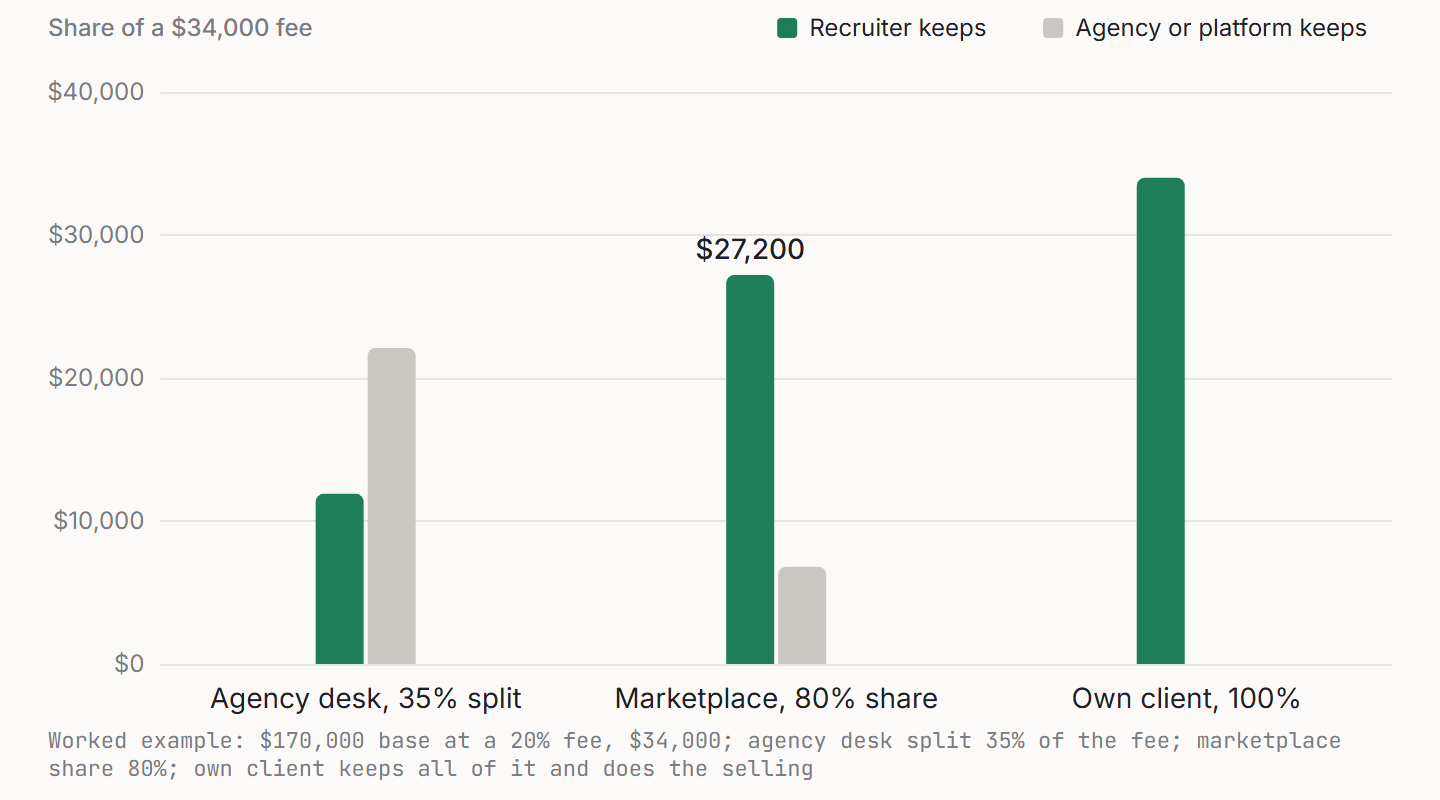
So the honest framing is a ladder. Not selling costs 65% of the fee at the agency, 20% on the marketplace and nothing with your own client, and what separates the rungs is who signed the company.
What the sales half of a full desk actually takes each week
Ask a 360 recruiter how much of the week is selling and the answer depends on what you count. Recruiterflow's write-up on business development says top-performing firms protect 20 to 30% of recruiter time for it, and that is the prospecting alone: the list, the calls, the emails, the pitch meetings.
The order does not stop needing selling once it exists. Someone qualifies it, negotiates the fee, agrees the terms, runs the weekly update, chases feedback, and re-sells the search when the first shortlist is rejected.
| The sales half | Hours in a 45-hour week | Who carries it on a marketplace |
|---|---|---|
| Prospecting, calls, pitch meetings | 9 to 13 | The platform |
| Qualifying the order, the fee, the terms | 2 to 3 | The company, when it posts the role |
| Client updates, chasing feedback | 3 to 4 | The platform |
| Re-selling after a rejected shortlist | 2 to 3 | You, and less of it when the decline carries a reason |
| Total | 16 to 23 |
The first row is Recruiterflow's number and the other three are my estimate. Count all of it and the commercial half of a full desk is close to half, 16 to 23 hours of a 45-hour week. The prospecting is the part everyone means by selling. The rest is the part that eats the afternoons.
The selling half also sets the fee, and rarely in your favour. Jon Brooks's piece on why recruiters all look the same quotes the two lines every independent hears: that all recruiters look the same, and that everyone else has agreed to 15%, so you should too. A desk that sells alone negotiates alone. A role posted with the fee already set has skipped that conversation, and the percent is whatever the company chose when it posted.
How a marketplace role is an order already placed
On Chosen the order exists before you see it. The company posted the role and set the fee, a percent of first-year base. Chosen runs the intake call, and the recording and transcript land on the role once published, with a brief of up to seven ranked requirements. The role card shows the company, the band, your dollars at both ends and the $200 finalist bonus. You keep 80%. Chosen holds the contract, invoices the company and manages the relationship.
An order that already exists changes the shape of the week. There is no prospecting block, no fee call, and the client update is the platform's problem. What is left is the delivery half, which is the half most recruiters got into the trade for.
What you give up when someone else owns the client
Four things, all real. First, the relationship: the company belongs to the platform, so the repeat order goes to the board, not to your phone. Second, the fee: you did not set it, so you cannot raise it by persuasion. Third, exclusivity: the platform decides how many recruiters work the role, and on a winner-take-all role every packet but the winning one is unpaid work, finalist bonus aside. Fourth, the cut: $6,800 in the worked example.
The specifics on Chosen. Once a role is published the fee can be raised but never lowered. Your share is released once the company's fee reaches Chosen in cleared funds. Place a candidate Chosen introduced at a client Chosen introduced, outside the platform and within 12 months, and you owe Chosen 20% of that fee. Chosen does not guarantee that any role will be filled. It is also small, with 13 approved recruiters as of September 2026.
None of that is hidden, and none of it is unusual. It is what owning the client is worth to the party that owns it. The question is only whether the 20% is cheaper than the hours.
Who this is for and who should keep selling
Keep selling if companies call you back. A recruiter with three clients who re-order is holding the most valuable asset in the trade, and 100% of the fee plus the relationship beats 80% of it, every year, for as long as the relationship lasts. A marketplace is a place to fill a quiet quarter, not a replacement for a book.
Stop selling, or never start, if you have the craft and no clients. That is the laid-off in-house recruiter, the 180 delivery recruiter who wants out of the 35% split, and the specialist whose network is deep and whose order book is empty. For that recruiter the marketplace pays 2.3 times the agency desk per placement and asks for no sales calls.
The honest trade for the agency recruiter is the base. Glozo puts it at $50,000 to 90,000, and the base is what pays the rent in a quarter with no placements. Search-only on a marketplace has no base. It has $27,200 per placement and nothing in a month when nothing closes. Price that against your own placements per year before you resign.
One more number. Call the sales half 22 hours a week, the top of the table, which over 50 weeks is 1,100 hours of selling. Glozo's illustration of an agency desk places ten candidates a year, so the sales half costs about 110 hours per placement. The $6,800 a marketplace keeps on the worked example works out to $62 an hour for those hours.
If your selling hour is worth more than $62, keep selling. If it is worth less, or worth nothing because nobody calls back, the price is fair.
Count the clients who re-order. If the number is zero, apply to a board where the order is already placed, and spend the selling hours on the search.
Questions people ask next
How do I get job orders without cold calling?
Three ways. A 180 seat in an agency, where the sales team wins the orders and you keep 30 to 50% of the fee. A split network, where the order's owner shares it. A marketplace, where the company posts the role with the fee set; on Chosen you see the company, the comp band and your dollars before you apply.
Is 80% to the recruiter actually good?
Against an agency desk, yes: Glozo puts an agency recruiter's cut at 30 to 50% of what the agency collects, so 80% is roughly double. Against your own client it is 20% less, and the 20% buys the client, the contract, the intake and the invoicing. Whether that is a good price depends on what your selling hours earn elsewhere.
How do agencies split fees with their recruiters?
Most pay a base plus a commission on what the desk bills. Per Glozo: a base of $50,000 to 90,000 and a cut that is 30 to 50% of what the agency collects, so a $34,000 fee pays the recruiter about $10,000 to 17,000. Going direct keeps the whole fee and drops the base; a marketplace sits between, at 80%.
Sources
- Recruiter salaries 2025, freelance versus agency, Glozo. Accessed Sep 30, 2026
- The top 25% of firms do recruitment business development differently, Recruiterflow. Accessed Sep 30, 2026
- What is 360 recruitment? Full-desk recruiting explained (2026), Pin. Accessed Sep 30, 2026
- Recruiters, they all look the same, Added Value from Jon Brooks. Accessed Sep 30, 2026