What an independent recruiter actually needs on day one
One client, one contract and a place to keep candidates; renting the standard tool stack costs about $4,000 a year before any fee lands, and $0 is possible.
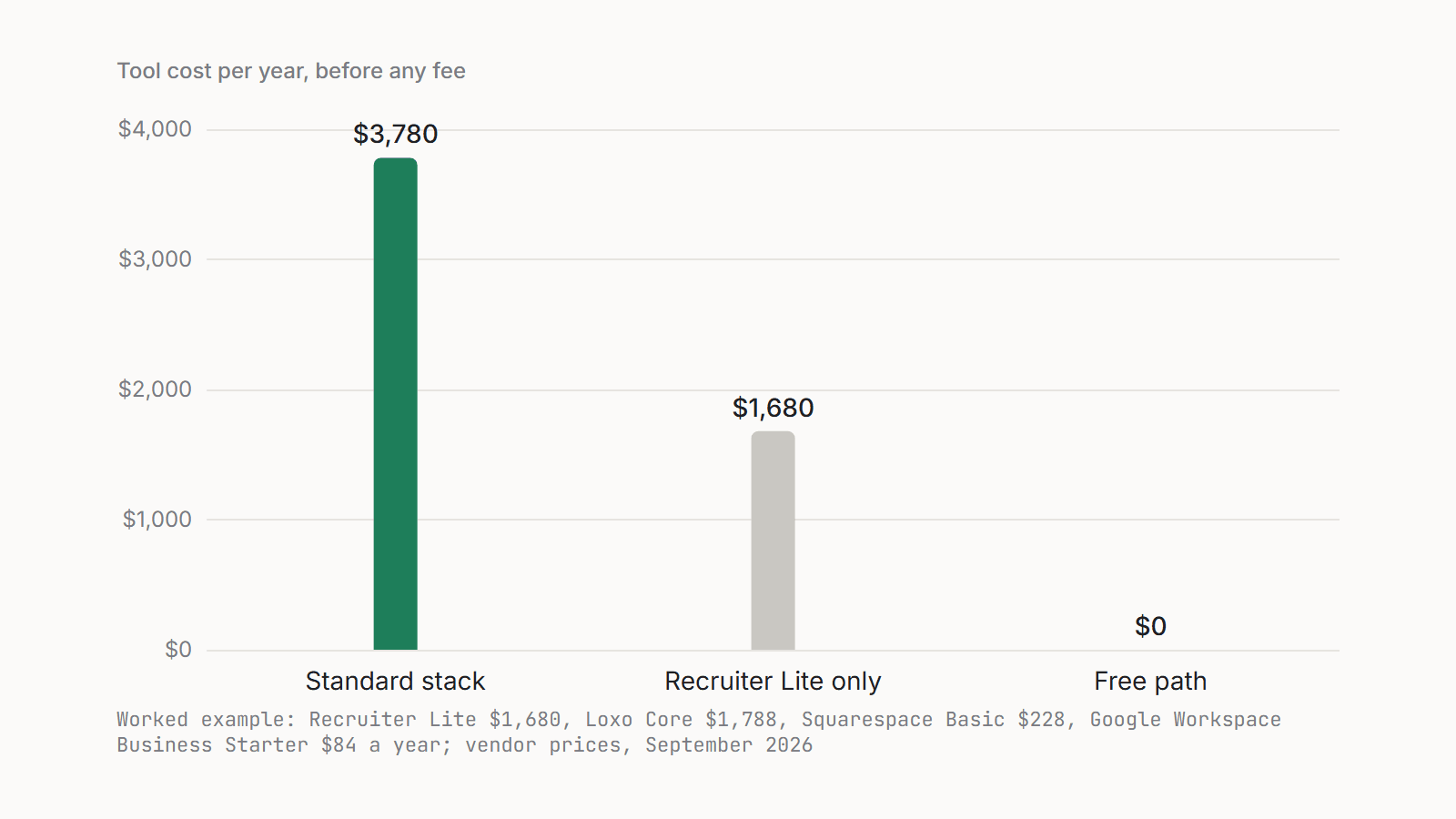
Three things: one client, one contract and a place to keep candidates straight. Bought the standard way, the tools alone cost $3,780 a year, billed from month one, and the first fee lands around month five at best. Supplied by a marketplace, the same three cost $0 up front and a share of the fee. Here is the ledger.
Clients, tools and contracts on day one
The question usually arrives as a shopping list: clients, tools, contracts, in that order, with a price expected beside each. Here is the list priced two ways, bought on your own or supplied by a marketplace that already has the clients.
| You need | Bought on your own | Supplied by a marketplace |
|---|---|---|
| A client | Weeks of outreach before the first job order; you keep the whole fee | An application; the fee is set before you apply and you keep a share of it |
| A contract | One fee agreement per client, drafted once by a lawyer | One agreement with the platform, signed once, covering every client it brings |
| A place to keep candidates | A CRM seat at $1,788 a year, or a spreadsheet | The platform's ATS, when it has one, at no cost |
The order is the point. A client comes first because nothing else on the list produces money. The contract comes second because it turns a handshake into a collectable fee. The tools come last because they are the only line that bills you whether or not a client exists, and the standard advice puts them first.
Most of the checklist is tooling for a business that does not exist yet
The standard checklist for a new independent desk is a CRM, LinkedIn Recruiter, a website, a fee agreement template and a pipeline of prospects, all in place before you take a search. It comes from agency owners and from the people who sell the tools, and it is a fair description of what a five-desk agency runs on.
A solo desk on day one is not a five-desk agency. It is one person with zero clients, and most of that list is infrastructure for clients who do not exist yet. Priced on the day I wrote this, the stack runs $3,780 a year, and three of its four lines want the year paid up front.
Take the worked example I will use through this post: a $150,000 base at an 18% fee, which is $27,000 when the hire starts. One fee pays for seven years of the stack. The stack, though, bills from month one, and the fee lands in month five at the earliest, after a client is signed, a search is run and a notice period is served.
What you need on day one is one signed client and a way to keep candidates straight. The rest is a way to feel like a business before you are one.
The client, and the one place where the client step is an application
A client is a company that has agreed in writing to pay you a percent of first-year base when your candidate starts. Getting one on your own is business development: a list of companies hiring the roles you know, a first message that is not a pitch, a call, a fee conversation, a signed agreement. In my experience it takes weeks, and the first client rarely comes from a cold message. It comes from someone who has watched you work.
The checklist calls this the pipeline of prospects, and it is the one item on the list you cannot buy. Recruiter Lite does not sell for you. A CRM does not sell for you. Nobody has hired a recruiter because the recruiter had a nice website.
One place turns the client step into an application: a marketplace that holds the client agreements. On Chosen, Nhat reads every recruiter application, usually within 3 business days. Approved, you apply to roles with the fee already set, and the role card shows the company's name, its comp band and your dollars at both ends of it. You keep 80% of the fee, and the ATS comes free with approval: search, sourcing, a screening assistant and a booking link.
One thing a marketplace does not give you is the relationship. The company is the platform's client, not yours, and when the role closes you are back on the board looking for the next one. For a desk with no clients that is a good trade. For a desk that wants its own book in three years, it is a place to start, not a place to stop.
The contract, and why one agreement can cover many clients
A good fee agreement is short. It needs five things: the percent of first-year base, when the fee is owed (when the hire starts, not at offer), the replacement guarantee and what voids it, how long your introduction counts if the company hires the candidate later, and what happens if the company hires around you.
Have a lawyer draft it once and reuse it for every client. It is the one line on the day-one ledger where paid professional time is worth it, because the contract is what makes a fee collectable.
The free template is the mistake I see most. A template from a forum has a percent and a guarantee and nothing about ownership or circumvention, which are the two clauses that decide whether you get paid when a client hires your candidate through a side door in month four.
On Chosen you sign one agreement, once, and it is published in full. Chosen is the contracting party with every company, invoices the fee and collects it, so you never invoice a client, and your share is released once the company's money clears. Your own clients outside Chosen still need your own contract. The limit is scale: as of September 2026 there were 13 approved recruiters on Chosen, and approvals are capped so that live roles outnumber them.
The tools, priced by the month against the first fee
Here is the standard stack, priced on the day I wrote this from the pages linked in each line. LinkedIn Recruiter Lite is $170 a month, or $1,680 a year on the annual plan, per Pin's 2026 LinkedIn Recruiter pricing breakdown. A Loxo Core seat is $149 a user a month, billed annually and paid up front, per Pin's Loxo pricing write-up, so $1,788 a year.
The website and the email are the cheap lines. A Squarespace Basic site is $19 a month on the annual plan, per Squarespace's pricing page, so $228. Google Workspace Business Starter is $7 a user a month, per Google's pricing page, so $84.
| Line item | A year |
|---|---|
| LinkedIn Recruiter Lite | $1,680 |
| One CRM seat, Loxo Core | $1,788 |
| A website, Squarespace Basic | $228 |
| Business email, Google Workspace | $84 |
| The standard stack | $3,780 |
| Recruiter Lite only | $1,680 |
| The free path | $0 |
The sum is $3,780 a year, or $315 a month, and the monthly figure flatters it. Three of the four lines are billed for the year up front, so by month five you have paid $3,731 and the first fee has not arrived. The CRM is a filing cabinet with a subscription, and a desk with eleven candidates in play does not need one yet.
The two other rows are the paths I would actually consider. Recruiter Lite only is the middle path: your sourcing lives on LinkedIn, so keep the seat and run everything else on free tools, $1,680 a year. The free path is the ATS that came with approval above, LinkedIn's free tier and the Gmail you already have, $0.
Its limit is real: the free ATS has no LinkedIn integration, so you work in two windows and paste between them. The application accepts a personal Gmail, so the business email can wait as well.
Now put the fee against it. A $150,000 base at 18% is $27,000. With your own client and the standard stack, year one nets $23,220 on one placement, plus the weeks of selling that produced the client. On the marketplace path, 80% of $27,000 is $21,600, the tools cost $0 and nobody sold anything. The gap is $1,620 for the year.
At three placements a year the gap widens to $12,420, because the platform's share scales with your volume and the tool stack does not, which is the honest case for building your own book eventually. Day one has zero placements.
What I would sign up for on day one
Sign one client before you buy anything with a monthly price. If a former hiring manager trusts you, that is your client, and one is enough. If nobody does yet, apply to a marketplace that shows the fee before you apply, because an application is the cheapest client acquisition in this trade and it costs an hour.
Sign one contract. Your own, drafted once by a lawyer, if the client is yours; the platform's, read in full, if the client is the platform's. In both, read the ownership and circumvention clauses twice.
Keep every candidate in one place from the first call, in a free ATS if you have one and a spreadsheet if you do not. Buy Recruiter Lite only if your sourcing already lives there, and buy it by the month until a fee has landed: five months at $170 is $850, against $1,680 for a year you may not need.
Skip the website and the CRM. The first fee pays for the whole stack seven times over, and by the time it lands you will know whether you want either.
Find the client first, sign the contract second, and let the first fee buy the tools.
Questions people ask next
How do I become a freelance recruiter with no agency experience?
Keep the craft and borrow the rest. Contingency work adds three things in-house never taught you: fee terms, a contract and several searches at once. A marketplace supplies the first two. Chosen's application asks for your LinkedIn, accepts a personal Gmail, and a person reads it usually within 3 business days, then Nhat emails you himself.
Do I need an LLC and insurance before my first recruiting fee?
Usually not before the first fee; before you sign a client who requires either, yes. Some clients accept a sole proprietor with a W-9 and some want an entity or a certificate of insurance. Chosen contracts with you as an independent contractor and asks for a W-9, or a W-8 outside the US, before paying. Ask an accountant.
What is the best free ATS for an independent recruiter?
The one you will open every day. Approved recruiters on Chosen get the ATS free with no plans or tiers: candidate database, smart and boolean search, resume parsing, custom fields, bulk export, sourcing with email lookup, Gmail outreach with daily limits, a booking link and a screening assistant. Not today: a LinkedIn integration, Outlook or automated sequences.
Sources
- LinkedIn Recruiter pricing 2026, full cost breakdown, Pin. Accessed Sep 30, 2026
- Loxo pricing, plans and what they cost, Pin. Accessed Sep 30, 2026
- Squarespace pricing, Squarespace. Accessed Sep 30, 2026
- Google Workspace plans and pricing, Google. Accessed Sep 30, 2026