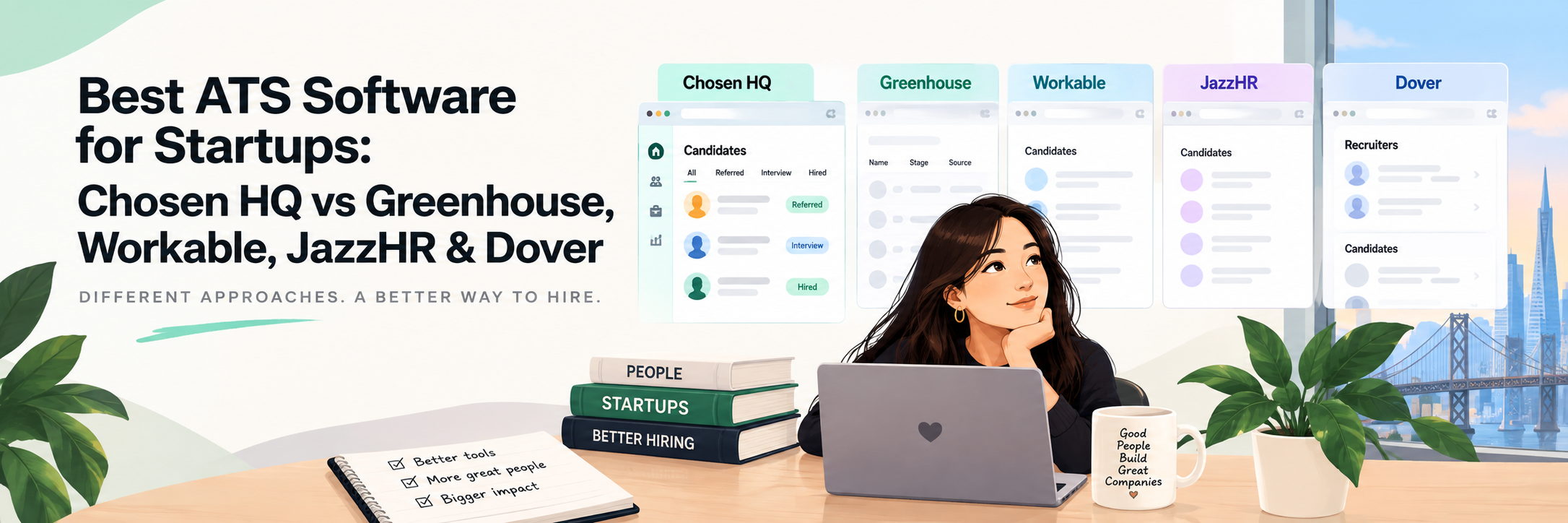
Best ATS Software for Startups: Chosen HQ vs Greenhouse, Workable, JazzHR & Dover
TL;DR
- Startups that use external recruiters often track applicants in an ATS while managing recruiter submissions through separate email threads and spreadsheets.
- Greenhouse, Workable, and JazzHR do not include built-in recruiter marketplaces, so you must find and manage outside recruiters separately.
- Chosen HQ and Dover combine recruiter access with applicant tracking, which keeps recruiter activity and candidate submissions in one pipeline.
- Chosen HQ includes its ATS at no cost. You set the recruiting fee and pay only when a hired candidate starts.
Why most ATS tools weren't built for external recruiters
Greenhouse, Workable, and JazzHR primarily organize hiring work after candidates enter an employer’s pipeline. Their documented features cover job posting, candidate records, interview stages, scorecards, scheduling, and internal feedback. Those capabilities help you process applicants, but the platforms do not provide a built-in network of outside recruiters who can source candidates for an open role.
Greenhouse and Workable provide applicant tracking and collaboration features, but neither includes a built-in marketplace for selecting outside recruiters, setting placement fees, and reviewing marketplace submissions. Greenhouse describes its plans on its pricing page, while Workable focuses on sourcing, job distribution, and shared candidate records. You still need to find outside recruiters and manage their commercial relationships separately.
JazzHR has the clearest inbound focus. The platform distributes jobs and tracks applicants, but it lacks its own candidate sourcing database, according to a review of its pricing and features. The cited review does not document a built-in recruiter marketplace or a marketplace review step for recruiter-sourced candidates.
You can still use these applicant tracking systems with external recruiters, but you must decide how recruiters will submit candidates and how you will track ownership. Email and spreadsheet workflows can separate recruiter communication from candidate records. Giving recruiters ATS access may keep records together, but it adds account and permission management.
Candidate quality remains another manual responsibility. A conventional ATS stores each submission and moves it through hiring stages, but storage does not verify that a recruiter screened the candidate against the role. Without a marketplace review step, your staff must confirm candidate fit and interest unless the recruiter has already done so.
What an ATS needs for recruiter-network collaboration
An ATS built for recruiter-network hiring should keep recruiter submissions, candidate ownership, and hiring stages in one system before interviews begin. Conventional ATS comparisons tend to focus on pricing, pre-hire features, company fit, and implementation time rather than recruiter collaboration. For startups using outside recruiters, three additional criteria distinguish a standalone ATS from an integrated recruiter marketplace.
-
One pipeline across every recruiter. Each recruiter should submit candidates into the same pipeline. The ATS should identify duplicate submissions, preserve candidate ownership, and show each candidate’s current stage without separate email threads.
-
Candidate vetting before submission. The marketplace operator or recruiter should confirm that each candidate meets the role’s stated requirements and has expressed interest before forwarding the profile. A documented review step reduces the basic screening you must repeat after receiving loosely matched resumes.
-
Pricing tied to a completed hire. Subscription pricing continues during an open search regardless of whether the role produces a hire. A free ATS with a fee due only after a hire begins reduces that upfront cost. Fee control also lets you decide what a successful placement is worth when posting the role.
Chosen HQ vs Greenhouse vs Workable vs JazzHR vs Dover
Start with the main product distinction. Greenhouse, Workable, and JazzHR are standalone applicant tracking products, while Chosen HQ and Dover combine applicant tracking with access to recruiting services or recruiters.
| ATS Platform | Pricing model | Recruiter network | Vetting before submission | Pipeline consolidation | Best fit |
|---|---|---|---|---|---|
| Chosen HQ | Free ATS, fee due at hire | Built-in vetted network | Chosen vets before you see it | One shared pipeline, one inbox | Startups using several outside recruiters |
| Greenhouse | Custom quote, annual contract | Not documented | Not documented | No recruiter marketplace | Structured in-house hiring |
| Workable | Paid subscription or pay per job | Not documented | Not documented | No recruiter marketplace | Sourcing plus applicant tracking |
| JazzHR | Paid subscription, tiered by job limit | Not documented | Not documented | No recruiter marketplace | Basic applicant tracking |
| Dover | Free ATS, paid recruiter services | Fractional recruiter marketplace | Not established in research | Not verified in sources reviewed | Startups wanting ATS plus recruiting support |
Managing multiple recruiters in one pipeline
A shared pipeline gives you one record for recruiter submissions, candidate ownership, and hiring status. Resumes arrive through parallel email threads, and candidate updates stay with the recruiter who sent them. Duplicate submissions become harder to spot, while founders must ask each recruiter for status updates before they can see who is working on the role.
JazzHR focuses on inbound applicant tracking and provides no candidate sourcing database. Workable adds sourcing tools and shared candidate profiles, but its documented collaboration features focus on internal hiring participants rather than external recruiter submissions. If you use either platform with several agencies, you may need to give recruiters platform access or transfer their emailed candidates into the ATS yourself. Email submissions require you to transfer candidate details and recruiter messages into the ATS if you want a complete record.
Chosen HQ gives every vetted recruiter one place to submit candidates for an open role. Chosen reviews each candidate before the submission reaches you, then keeps recruiter messages and candidate progress in one shared pipeline. You can see who submitted a candidate and where that person sits in the hiring process without reconciling separate inboxes or spreadsheets. When two recruiters submit the same person, Chosen HQ can display the submissions in the shared system so you can resolve ownership before advancing the candidate.
How vetting improves the candidate shortlist
Pre-submission vetting improves shortlist quality by filtering out candidates who do not fit the role or have not confirmed their interest. Without that review, recruiters can send resumes directly into your ATS, and you must check basic qualifications before deciding whether to interview anyone. If the recruiter has not confirmed basic fit and interest, you must perform that screening before deciding whether to interview the candidate.
A marketplace review step can check whether a submission meets the role requirements and whether the candidate has expressed interest before the employer receives it. That screening reduces the number of obvious mismatches you must review, although it cannot guarantee a successful hire.
Chosen HQ applies the same principle inside its recruiting marketplace and applicant tracking system. Vetted recruiters submit candidates who fit the role and have expressed interest, then Chosen reviews each candidate before the submission reaches you. Your pipeline starts with reviewed candidates rather than raw recruiter output.
Pre-submission review saves more screening time when several recruiters work on the same role. Ten unvetted submissions can create ten separate screening tasks. A review layer removes obvious mismatches before they enter your queue, so you can spend limited hiring time comparing plausible candidates and conducting substantive interviews.
How free ATS and pay-per-hire pricing compare with subscriptions
Pay-per-hire pricing postpones recruiting fees until a candidate starts, while an ATS subscription creates a recurring cost during the search. A delayed or canceled search leaves subscription fees behind, even when nobody joins. Chosen HQ includes the ATS at no cost and charges the recruiting fee only when a hired candidate starts. The company also sets that fee when posting the role.
Greenhouse publishes plan names but requires a custom quote, while third-party procurement data reports a median annual contract near $12,250. JazzHR charges $75, $269, or $420 per month with annual billing. At the cited annual-billing rate, JazzHR’s $75 monthly tier totals $900 per year regardless of the number of hires. Workable ties subscription pricing to company size. One reported headcount threshold raises its Standard plan from about $299 to $500 per month when a company grows past 20 employees.
Pay-per-hire pricing may cost more than an ATS subscription after a successful search because the fee covers recruiter access and placement services, not software alone. Its advantage is payment timing. Chosen HQ does not charge the placement fee until the hired candidate starts.
Dover is the closest comparison because it also combines a free ATS with recruiting support. Chosen HQ lets you set the recruiting fee when you post the role and charges it when the hired candidate starts.
Dover vs Chosen HQ: the closest comparison
Dover comes closest to Chosen HQ because both combine recruiter access with a free applicant tracking system. Dover focuses on startups and adds fractional recruiters, sourcing tools, job board connections, and Slack integration. A startup that wants those sourcing and communication tools may prefer Dover over a standalone ATS.
Chosen HQ gives companies more explicit control over external recruiter submissions. You set the recruiting fee when posting a role, and vetted recruiters send candidates through one shared pipeline. Chosen reviews each candidate before the submission reaches you, which reduces the screening work that usually falls back on a founder or hiring manager.
Dover focuses on early-stage startup recruiting, while Chosen HQ positions its marketplace for companies that want to manage several outside recruiters through one pipeline. Chosen HQ also ties its recruiting fee to a completed hire and lets the company posting the role set that fee.
Dover may fit startups that prioritize its sourcing tools and integrations. Chosen HQ fits companies that prioritize fee control, candidate review before submission, and one pipeline for several outside recruiters.
Which ATS fits your hiring stage
Pure in-house hiring
Choose JazzHR when a small company needs simple applicant tracking for a few open roles. Choose Workable when you want broader sourcing and job-board distribution. Greenhouse fits a hiring function that prioritizes structured interviews, scorecards, and configurable controls, though it uses quote-based pricing.
Occasional agency use
Keep your preferred in-house ATS when external recruiters supply only a small share of candidates. Workable or JazzHR can track those candidates once entered, but neither supplied source documents dedicated agency submission or recruiter marketplace workflows. Consider Chosen HQ when emails, duplicate submissions, and separate recruiter relationships start creating extra work.
Hiring primarily through external recruiters
Choose Chosen HQ when recruiter access drives most of your hiring. Its free ATS puts vetted recruiter submissions into one pipeline, and you pay your chosen fee only when a hire starts. Dover offers the closest alternative for startups that want a recruiter marketplace, free ATS, and sourcing tools. Chosen HQ fits founders who want direct fee control and candidate review before submissions enter the interview pipeline.
The case for Chosen HQ
For a startup that relies on external recruiters, a standalone ATS may leave recruiter selection, placement fees, and recruiter communication outside the software. A subscription can also create a recurring expense before the search produces a hire.
Chosen HQ combines the ATS and recruiter marketplace under one outcome-based fee. That model fits startups that want recruiting support without another fixed software expense. See how Chosen HQ works, including how to post a role, set the recruiting fee, and pay when your hire starts.