How to hire a senior engineer in four weeks with no recruiter
Work backwards from day 20: brief by day 2, first conversations by day 5, onsite by day 12, offer by day 16, and a start date the notice period sets.

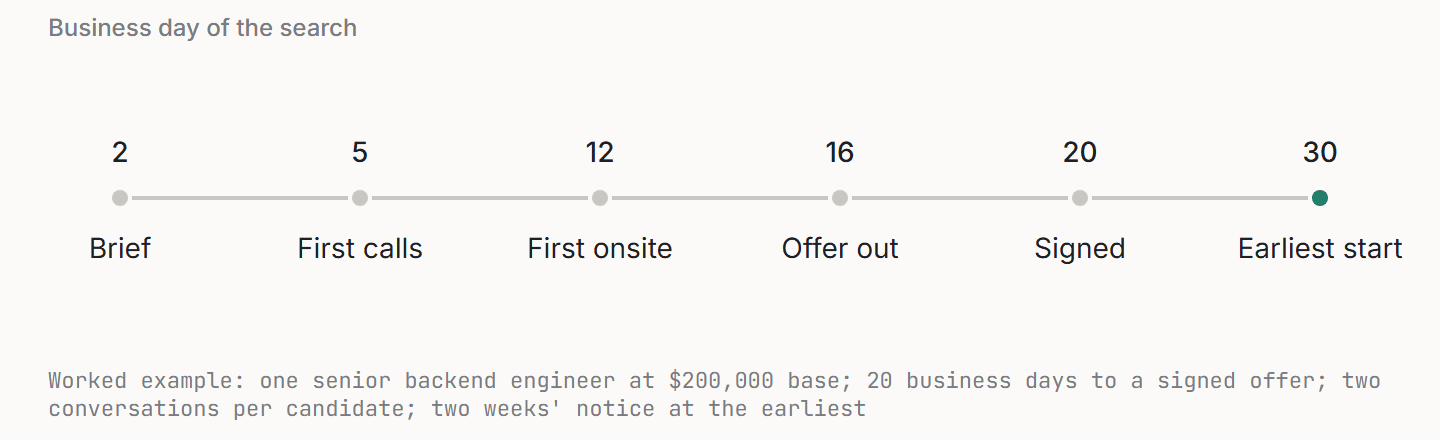
Four weeks gets you a signed offer, not a start date. Build the calendar backwards from day 20: brief by day 2, first conversations by day 5, first onsite by day 12, offer out by day 16, signature by day 20. The start lands two to four weeks after that, and no offer changes it.
A senior engineer in four weeks with no recruiter
Twenty business days is the plan, and the plan is a table. Every row is a deadline for one specific thing, and the last row is the one the question forgets.
| Business day | What must be true |
|---|---|
| 2 | The brief is written, with a salary band |
| 5 | Twenty names are in hand and the first conversations have started |
| 12 | The first onsite has happened |
| 16 | The offer is out |
| 20 | The offer is signed |
| 30 to 40 | The engineer starts, after two to four weeks of notice |
The example I will run: one senior backend engineer at $200,000 base, hired by an engineering manager with two other open roles and nobody whose whole week is hiring. Your own time comes to about 32 hours across the four weeks, and your two interviewers give about 14 more. If an outside recruiter's candidate is the one who signs, a 20% fee is $40,000, owed when they start.
The deadline earns its keep because a search is expensive in ways that never reach a bank statement. SHRM's 2022 piece on recruiting costs quotes an estimate that the total cost of a hire can reach three to four times the position's salary, most of it the time managers and leaders put in. Whatever the exact multiple, four weeks of that costs less than twelve, and the offer goes out two months sooner.
Day 20 is the offer, not the start date
The standard line is that a senior engineering hire takes two to three months and a four-week target sets you up to fail. The medians agree. SHRM's median time to fill for 2025, as quoted by Pin's 2026 funnel benchmarks, is 45 days; Pinpoint's Q4 2025 figure for technology on the same page is 48 to 49. Time to fill usually stops at the accepted offer, so that is seven weeks to a signature, mostly at companies with an HR department.
I think the two-to-three-months line is right about the wrong thing. It measures a loop with five stages, and five stages means four scheduling gaps, each three to five business days while three calendars look for an hour. Two conversations have one gap. Take the other three out and 45 calendar days becomes 20 business days, with no change in how carefully you look.
The part that does not compress is the notice period. Two weeks is the US custom, senior people often owe a month, and no offer letter shortens either. So four weeks to a signed offer is a calendar problem, and four weeks to a start date is a wish unless the person is already out of work.
A four-week deadline with a two-week notice period inside it is a six-week deadline with a shorter name. Decide which one you meant before day 1. If it is the second, the only honest bridge is a contractor for the six to eight weeks the search and the notice take, with the search running underneath.
Days 1 to 5, the brief and the first twenty names
Days 1 and 2 are the brief: what this person will own by the end of their first quarter, the must-haves (three at most), the nice-to-haves, the one thing that rules a person out, the base band, and the two reasons a good engineer would leave a good role for this one.
For a senior engineer the must-haves are evidence, not years. Shipped a system like the one you need, owned it in production, made a call you can ask about. Fifteen years of experience is a fact about time.
Days 3 to 5 are twenty names, and with no recruiter that means two lists. Ten from you and your team: people who left companies you rate, people whose pull requests you have reviewed, the engineer your best engineer keeps mentioning. Ten from outside, through a recruiter working the brief or your own hour a day on the tools you already pay for.
The first message goes out on day 3 with the band in it. Senior engineers answer fewer messages than anyone, so in my experience twenty names is eight first calls, and eight is what the loop needs.
The outside list is where Chosen fits, so read this paragraph knowing I built it. You post the role and set the fee, and the recruiters Chosen approves onto it work from a recorded intake call with your team. A person at Chosen approves a recruiter and reviews packets usually within a business day. At $200,000 base a 20% fee is $40,000, owed when the engineer starts. Chosen does not guarantee that any role will be filled. Keep your own ten names on the list.
Days 6 to 12, the two-conversation loop
Two conversations per candidate, and the same two for everyone. The first is 45 minutes, days 5 to 9, eight of them: their last system told by them, what broke, what they would do differently, then ten minutes of you selling the problem with the band already known. Score against the must-haves the same day, in writing. Three go forward.
The second is the onsite, in one block rather than four. Three hours in one afternoon with the two interviewers who will work beside them. Ninety minutes building on a real piece of your system with their own tools and whatever AI they use in real life. Forty-five minutes with the team on how they work. Forty-five minutes with you on the first 90 days and what worries them. The first onsite happens by day 12 and the last by day 14.
The trick that makes day 12 possible is a request on the first call: every candidate holds two afternoon slots in the second week before either of you knows whether they will be needed. Calendars, not judgement, are what turn a loop into three months. Nothing in the loop is a take-home. A senior engineer with two other processes running will not do one, and the work session shows you more anyway.
The hours: eight first calls is six, three onsites is nine for you and thirteen and a half across the two interviewers, and half an hour of notes after each conversation is another five and a half. Add four for the brief, five for the hour a day on the outside list in week one, and two and a half for references and the offer, and you are at 32.
Days 13 to 20, the onsite and the offer
Day 15 is the decision, made the day after the last onsite, from the written scores, by one person. Day 16 the offer goes out, on a call first and in writing the same afternoon: $200,000 base, equity stated both as a percent and as shares, the vesting schedule, the start date you want, and a decision date of day 20.
References run on days 16 to 18, two calls to people who managed them, and the written offer says it is subject to them so nothing waits. Day 20 is the signature.
Two things protect day 20. Keep the second finalist warm through it with an honest message: they are the second choice this time, and they will know by Friday. And hold the decision date unless the candidate asks for more time for a specific reason. Pin's benchmark page puts offer acceptance in technology at about 77%, so plan for the decline, which is the second finalist rather than a restart.
The cost, then, at the end of week four. About 32 hours of yours and 14 of your interviewers', and the fee only if the recruiter's candidate signed: $40,000 at 20% of $200,000, invoiced when they start in week six or eight. If your own list produced the hire, the search cost time and nothing else.
What to do when day 20 arrives empty-handed
It happens, and an honest plan says what it does when it does. Four moves, in order.
Look at where the funnel died. No first calls from twenty names means the message or the band. No onsites from eight calls means the brief. No signature from an offer means the money or the manager. Fix the stage that failed instead of adding volume everywhere.
Extend by two weeks with the second finalist and one new name from every person who said no, and set a new day 20. If two extensions have failed, the market has told you something about the band or the must-haves, and one of them has to move. And bridge the seat with a contractor for eight weeks while the search runs. A good contractor costs more per month than the employee and nothing per month after.
On a marketplace role the fee is also a lever. On Chosen the percent can be raised at any time and never lowered, and a raise reaches every recruiter already on the role, so a stalled role can be made worth more work without a repost. In September 2026 Chosen had 13 approved recruiters: small, and one channel among several.
Write the brief today, and put day 20 on the calendar with the offer on it, not the start.
Questions people ask next
I'm a solo founder hiring my first engineer. What are the steps?
Plan on 45 days and about 40 hours. A one-page brief with a salary band on day 1, twenty names by day 10 from your network and one recruiter, three conversations with each serious candidate through day 30, then references, the offer and the notice period. The job post goes up last, as a backstop.
We've had a staff engineer role open for five months. What do we do with a role nobody can fill?
Treat it as a brief problem before a sourcing problem. Cut the must-haves to three, check the band against what the last three finalists asked for, and look at where the pipeline dies. If it dies at the offer, the band is wrong; if nobody reaches an onsite, the brief is. Then raise the fee or reopen the channel.
How many interview rounds should a startup have for a senior engineer?
Two conversations inside twelve business days, a 45-minute first call and one onsite that combines a work session with the team conversation. Measure the loop in days, not rounds. Every extra round adds a scheduling gap of three to five days, and a senior engineer with two other offers will not wait through five of them.
Sources
- Recruitment funnel benchmarks 2026, conversion rates by stage, Pin. Accessed Sep 30, 2026
- The real costs of recruitment, SHRM. Accessed Sep 30, 2026
- Hiring through the marketplace, Chosen help center. Accessed Sep 30, 2026