Best Candidate Sourcing and Vetting Services for Startups
TL;DR
- Sourcing-only services cost less than full recruiting support, but early startups must screen, interview, and track candidates themselves.
- Agencies provide hands-on sourcing and vetting for specialized or urgent hires, but fees can make repeated hiring expensive.
- RPO providers run much of the recruiting function and suit later-stage startups with steady hiring volume and predictable staffing needs.
- Recruiting software gives startups maximum control at a lower recurring cost, but internal staff must operate the tools and assess candidates.
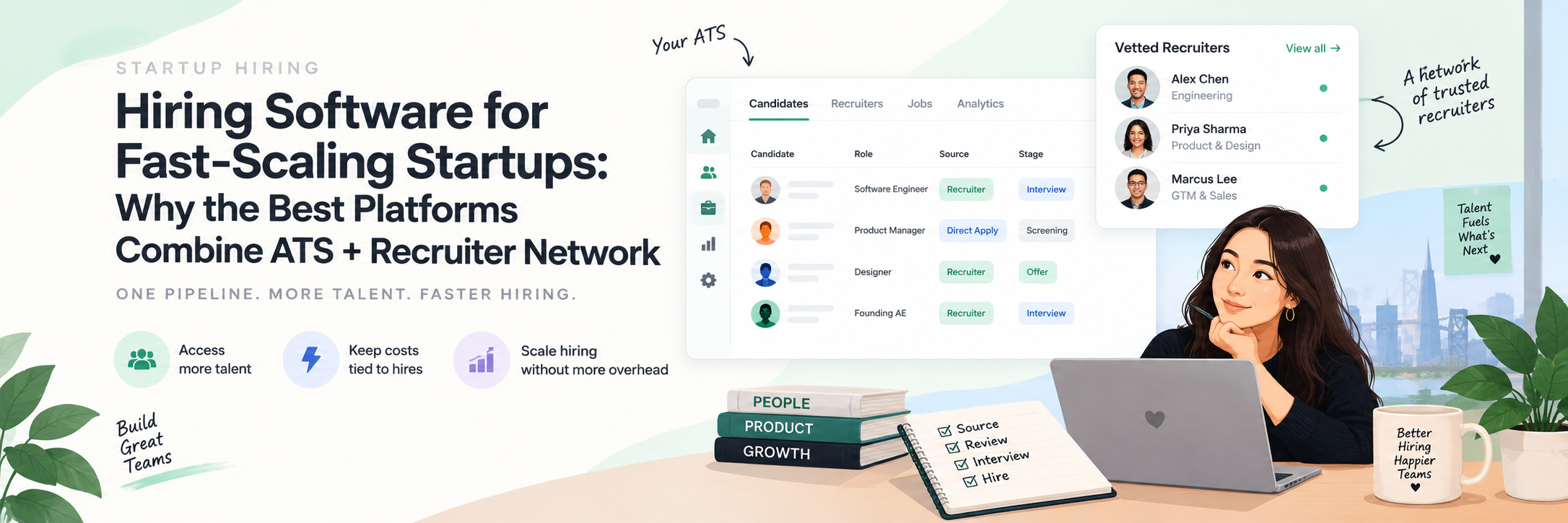
- Recruiter marketplaces balance outside support with company control. Chosen HQ connects startups with vetted recruiters, reviews candidates before submission, includes a free ATS, and charges the company-set fee only when a hire starts.
What "candidate sourcing" and "candidate vetting" actually mean
Candidate sourcing finds potential applicants and starts conversations with them. A sourcer searches professional networks, databases, and referrals, then contacts people who may match the role. Poor sourcing produces a narrow candidate pool, outdated contact lists, or low response rates. Even effective sourcing does not prove that a candidate can do the job.
Candidate vetting evaluates whether each sourced person fits the role. A recruiter may confirm relevant experience and genuine interest before checking compensation expectations or work authorization. Technical assessments, structured interviews, and reference checks can test skills more deeply. Weak vetting creates false positives that waste interview time or false negatives that remove qualified people too early.
Your choice of hiring service determines who owns each function and how candidate quality gets checked. Sourcing-only providers hand candidates to you for screening, while recruiting software may organize applicants without judging them. Agencies, RPO providers, and recruiter marketplaces usually handle some vetting before submission, but their methods and depth vary.
Before choosing a vendor, identify the evidence you expect with each candidate. A resume match offers less assurance than confirmed interest, recruiter notes, and a role-specific assessment. You also need to decide who will reject weak candidates, record the reasons, and adjust the search when early submissions miss the mark.
The five hiring service models compared
Each service model assigns sourcing, screening, and process management differently. Shortlist timing below provides a planning range, since role complexity, compensation, and search criteria can change it.
| Model | Role coverage | Vetting method | Pricing model | Typical time to shortlist | ATS workflow | Candidate quality controls |
|---|---|---|---|---|---|---|
| Sourcing-only service | Broad coverage when search criteria are easy to define | Usually checks profile relevance and contact details. You handle interviews and skills assessment. | Subscription, project fee, or price per candidate list | Several days to two weeks | Exports candidates or sends them into your existing ATS | Search filters, profile review, and list replacement policies |
| Recruiting agency | Often specializes by function, industry, or seniority | Recruiter screens experience, interest, compensation, and role fit | Contingency fee after hire or retained fee paid in stages | One to four weeks | Agency may use its own system and share candidates by email or portal | Recruiter screening, references when included, and replacement guarantees when contracted |
| Recruitment process outsourcing provider | Supports multiple roles and sustained hiring volume | Embedded recruiters follow an agreed screening and interview process | Monthly fee, project fee, per-hire fee, or a blended structure | Often one to four weeks after setup | Usually works inside your ATS or implements a managed workflow | Standard screening criteria, reporting, recruiter oversight, and process audits |
| Recruiting software or tools | Broad database coverage, but results depend on your search skills and employer reach | Automated matching, filters, or assessments. You make final screening decisions. | Monthly or annual subscription, sometimes priced by seat or usage | Candidate lists may appear immediately. A vetted shortlist can take days or weeks. | Standalone tool, ATS integration, or ATS included | Data filters, duplicate detection, assessments, and configurable screening rules |
| Recruiter marketplace | Coverage depends on the recruiters active in each specialty | Marketplace recruiters screen candidates before submission. Platform review may add another check. | Commonly a success fee paid after a hire | Several days to a few weeks | Candidates may enter one shared marketplace pipeline or connect to an ATS | Recruiter admission standards, submission rules, candidate review, and recruiter performance monitoring |
Your internal capacity should guide the first cut. The fee benchmarks and role-specific sections that follow help narrow the choice based on budget, hiring volume, and the depth of vetting each role needs.
What each model actually costs
Agency fees usually provide the clearest salary-based benchmark. Contingency agencies commonly charge 15 to 30 percent of the hire’s first-year base salary, while retained searches often reach 25 to 35 percent. A 20 percent fee on a $120,000 salary costs $24,000. Contingency fees become payable after a successful hire, while retained firms collect part of the fee before completing the search.
RPO providers more often charge a monthly management fee, a cost per hire, or a combination of both. Some contracts convert each hire into a percentage of salary, but hiring volume and contract length heavily influence that rate. You should calculate the total contract cost per expected hire before comparing an RPO quote with an agency percentage.
Sourcing services and recruiting software tend to use flat project, monthly subscription, or per-seat pricing. Startup ATS plans can cost several hundred dollars per month, while sourcing platforms may add separate fees for contact data or outreach capacity. These tools can lower the external fee per hire, but your company still pays for the staff time required to screen, interview, and close candidates.
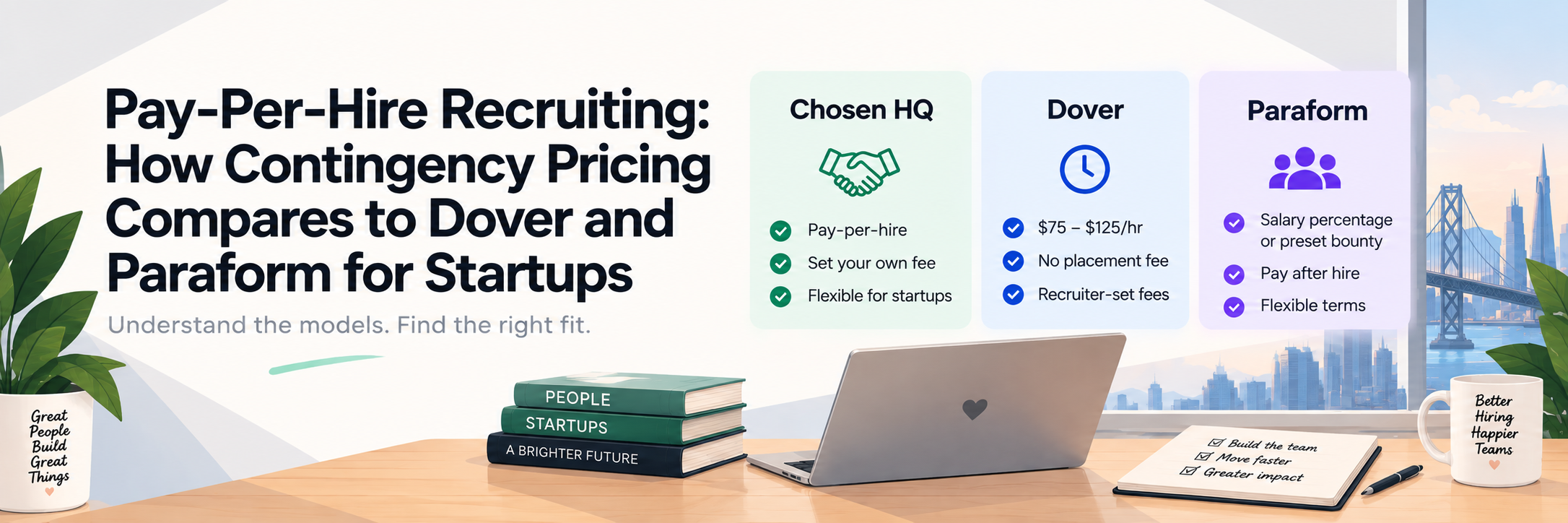
Recruiter marketplaces typically charge after a successful placement, often using a percentage of first-year salary or a posted fee. Chosen HQ lets the company set that fee when posting the role and collects payment only when the hired candidate starts. Its built-in ATS carries no separate software charge. Compare marketplace quotes by payment trigger, replacement terms, and which salary components determine the fee rather than assuming one marketplace model costs less than another.
Sourcing-only services
Sourcing-only services build the top of your hiring funnel. A vendor searches candidate databases and professional networks, then delivers profiles, contact details, or responses from interested prospects. The exact deliverable depends on the contract, but the vendor usually stops before detailed screening.
Your company still owns candidate vetting and the rest of the hiring process. An internal recruiter or hiring manager must confirm interest, assess skills, conduct interviews, manage ATS records, and close the chosen candidate. Search criteria and job-title filters can remove obvious mismatches, but they cannot confirm whether someone meets the role’s practical requirements.
Internal labor creates the hidden cost of a sourcing-only contract. Hiring managers may spend hours reviewing weak matches, running initial calls, and updating candidate records. Those hours can erase part of the savings offered by a lower vendor fee.
A sourcing-only service fits startups that already have recruiting capacity and a defined evaluation process. Startups without that capacity should compare services that include recruiter-led screening and centralized pipeline management.
Recruiting agencies
Recruiting agencies provide full-service support for individual searches. A recruiter sources candidates, screens for fit and interest, coordinates interviews, and may help negotiate the offer. A close relationship with one recruiter can improve candidate quality because the recruiter learns your role, hiring manager, and preferences over time.
Contingency agencies charge only after you hire one of their candidates, which limits upfront risk. Retained agencies receive part of their fee before the search ends and often require exclusivity. A retained search gives one recruiter a clear mandate, but the commitment reduces your ability to switch providers if the search moves slowly.
Agency economics can become difficult for a fast-growing startup because fees usually apply separately to each hire. Using several contingency agencies may expand coverage, but candidates can arrive through separate emails, spreadsheets, or agency portals. Unless every recruiter works inside your ATS, you may struggle to compare candidates, spot duplicate submissions, and see overall search progress. Agencies suit important one-off roles when you value close recruiter involvement, while repeated hiring requires careful review of fees, exclusivity, and workflow visibility.
RPO providers
Recruitment process outsourcing gives an external provider responsibility for part or all of your hiring function. An RPO team may manage sourcing, screening, interview coordination, reporting, and recruiter capacity across several open roles. The model works best when you have steady hiring volume and need a repeatable process.
RPO providers usually expect multiple recurring searches and a multi-month commitment. Early-stage startups can underuse reserved recruiter capacity when hiring pauses. They can also outgrow the agreed scope when headcount plans shift toward new roles, seniority levels, or locations.
An embedded RPO team gives you more operational consistency than separate agency searches. Recurring fees or contracted capacity can also make monthly costs easier to forecast. In return, you give the provider more influence over daily recruiting operations and commit to spending before every role produces a hire.
Agencies handle individual searches and commonly charge per placement, while recruiter marketplaces let you open roles as needed and compare candidates from multiple recruiters. Those models offer more control at the role level. RPO fits better when predictable hiring demand justifies outsourced infrastructure. A one-off engineering, sales, or operations hire rarely provides enough volume to use the model efficiently.
Recruiting software and ATS platforms
Recruiting software works best when you can supply the recruiting labor. An applicant tracking system stores applications, records interview feedback, and moves candidates through hiring stages. Some platforms also publish job posts, but they generally rely on applicants or your staff to fill the pipeline.
Sourcing tools help you search candidate databases and send outreach. Screening features may filter resumes, collect answers, or administer assessments. However, your hiring manager or internal recruiter still needs to verify skills, interest, compensation expectations, and role fit.
The DIY model can offer more control, but software fees exclude the staff time required for candidate sourcing and vetting. Before choosing a platform, calculate who will run searches, review profiles, contact candidates, and conduct initial screens.
Recruiter marketplaces can combine pipeline management with recruiter-sourced candidates. Chosen HQ, for example, includes a free ATS and routes candidates submitted by vetted recruiters into one shared pipeline. Chosen reviews candidates before they reach the company, so the software comes with a sourcing and review layer rather than serving only as a candidate database.
Recruiter marketplaces
Recruiter marketplaces give you access to several independent recruiters through one service. You post a role, define the requirements, and set or accept a success fee. Vetted recruiters then source candidates and submit them to a shared pipeline. You review the candidates, run interviews, and make the final hiring decision.
Marketplace quality depends on how the platform approves recruiters and checks their submissions. Strong controls can include recruiter screening, confirmation of candidate interest, and candidate review before the hiring company sees a profile. You should also check whether the marketplace prevents duplicate submissions and records which recruiter introduced each candidate.
Chosen HQ follows this model with a free built-in ATS. You post a role and set the recruiting fee, then multiple vetted recruiters can submit candidates. Chosen reviews each candidate before sending the profile to you. Every candidate and recruiter conversation stays in one pipeline, while a unified inbox replaces separate email threads with individual recruiters.
Chosen HQ charges the company-set recruiting fee only when a hired candidate starts. You can therefore open a search without paying an upfront retainer or separate ATS subscription. You still own interviews, assessments, references, and the final hiring decision.
Engineering recruiting
Engineering searches usually fit a specialized agency or recruiter marketplace when your startup needs external sourcing and meaningful pre-screening. Recruiters with technical domain knowledge can verify relevant project experience, confirm candidate interest, and reject obvious mismatches before submission. Your engineering lead should still own the work sample or technical interview unless the service explicitly includes skills assessment.
Sourcing-only tools work better when you already have enough internal capacity to review profiles and assess technical ability. The tool can expand the prospect pool, but your staff must turn that pool into a qualified shortlist. Under a tight deadline, profile volume can increase screening work without improving candidate signal.
A specialized agency offers focused ownership and can suit a narrow or senior search. A recruiter marketplace can run the search across multiple specialists while keeping submissions in one pipeline. Chosen HQ follows the marketplace model. Vetted recruiters submit candidates, and Chosen reviews each candidate before the company sees them. Its free ATS keeps recruiters and candidates in one workflow, while the company sets the fee and pays when a hire starts.
Before choosing either model, ask who performs the technical pre-screen, what evidence they review, and how they prevent duplicate or poorly matched submissions.
Sales recruiting
Sales recruiting works best with a specialized agency or recruiter marketplace that screens for sales performance before submission. Resume keywords can identify titles and industries, but they rarely verify whether a candidate met quota or succeeded in a comparable sales cycle.
A useful sales screen examines quota history, attainment by period, and the source of the candidate’s pipeline. The recruiter should also compare average contract value, buyer type, and sales cycle with your role. A rep who thrives on short inbound deals may struggle with long outbound enterprise sales, even when both jobs carry the same title.
Motivation requires direct assessment as well. Recruiters should ask why the candidate wants the role, what compensation structure they expect, and whether they understand the product and market. Generic sourcing tools leave those conversations to your hiring manager.
A specialized agency can provide deep knowledge within a sales niche. A recruiter marketplace can broaden coverage by letting several recruiters search while keeping submissions in one pipeline. Chosen HQ follows the marketplace model and reviews candidates before they reach you. Its free ATS keeps recruiter submissions together, and you set the fee that becomes payable when a hire starts.
Operations hiring
Recruiter marketplaces often fit early-stage operations hiring because the role can change as you review candidates. A startup may combine business operations with customer implementation, while candidates with the right experience may use different job titles. Rigid keyword searches can miss those adjacent profiles.
Flexible recruiter judgment helps translate an unclear brief into a workable candidate pool. Recruiters can compare backgrounds, test candidate interest, and use your interview feedback to adjust later submissions. Sourcing-only services leave that interpretation and screening work with you.
Choose a model that supports quick revisions without requiring a long retainer. A recruiter marketplace lets several recruiters search while you refine the scope in one pipeline. Chosen HQ follows this model with vetted recruiters, candidate review before submission, a free ATS, company-set fees, and payment when a hire starts. A specialized contingency agency can also work when one recruiter knows the relevant operations niche and does not require an upfront commitment.
Go-to-market hiring
Go-to-market hiring requires vetting for both domain knowledge and relationship skills. GTM hiring covers roles such as marketing and partnerships, along with customer success. A resume may show relevant industry experience without revealing whether a candidate can manage customers, explain a technical product, or build a repeatable program.
A specialized agency can provide useful judgment when the role has a clear profile. However, one recruiter may search within a familiar network and apply one interpretation of an ambiguous title. A partnerships role, for example, might require ecosystem expertise at one startup and outbound deal experience at another.
A multi-recruiter marketplace fits GTM searches when you need to test several candidate profiles. Multiple recruiters can search different networks while you compare every submission against one scorecard. Chosen HQ gives vetted recruiters one shared pipeline, reviews candidates before submission, and includes a free ATS. You set the fee and pay when a hire starts. Before opening the search, define the evidence each recruiter must provide, such as customer segment experience, campaign ownership, or deal scope.
A decision framework by startup stage
Choose a model based on hiring volume, available cash, and the amount of recruiting work you can handle internally. Funding stage provides a useful starting point, but your hiring plan and internal capacity should make the final decision.
- Pre-seed and seed startups should favor low-commitment models. Use sourcing software when a founder or hiring manager can screen candidates and manage outreach. Choose a recruiter marketplace when you need external vetting but want to avoid retainers. Chosen HQ fits the latter case because you set the fee, use the included ATS, and pay only when a hire starts.
- Series A startups usually need more recruiting capacity without a large internal team. A recruiter marketplace can cover several specialized searches through one pipeline. A specialized agency can make sense for an urgent executive or technical role that requires deep domain knowledge. Choose between them based on whether broader recruiter coverage or one dedicated recruiter better serves the role.
- Series B and later startups should prioritize a repeatable hiring process. An RPO provider can support sustained hiring when you need recruiters embedded in your company for an extended period. Recruiting software paired with internal recruiters offers more control when your company already owns sourcing and vetting expertise. A marketplace can still cover hard-to-fill roles or temporary hiring spikes.
If you expect only a few hires and lack screening capacity, start with a marketplace or specialized agency. If you expect steady hiring and can commit budget over several months, compare RPO with an internal recruiting function supported by software.
Vendor selection checklist
- Which hiring stages does the vendor own, including outreach, screening, interview coordination, and offer support?
- How does the vendor confirm each candidate’s skills, experience, compensation expectations, availability, and interest?
- Who reviews candidates before submission, and what information accompanies each profile?
- Does the vendor specialize in your role type, seniority level, industry, or hiring market?
- How quickly will the vendor deliver an initial shortlist, and what qualifies a candidate for that shortlist?
- Does the vendor charge a subscription, retainer, fixed fee, or percentage of first-year compensation?
- When does payment become due, and does the agreement require a minimum spend or exclusive search?
- What happens when multiple recruiters submit the same candidate?
- Can the vendor work inside your current ATS, or will you need to maintain a separate pipeline?
- Who owns candidate records, interview notes, and communication history if you end the contract?
- Does the vendor provide a replacement or refund when a hire leaves early?
- How long does any guarantee last, and which resignation, termination, or performance scenarios does it exclude?
- Can the vendor explain how it monitors recruiter quality and removes recruiters who submit poor-fit candidates?
- Which reports show outreach activity, candidate status, reasons for rejection, and hiring progress?
FAQs
- What is the difference between candidate sourcing and candidate vetting? Sourcing finds and contacts potential candidates. Vetting checks their skills, experience, interest, and fit before an interview.
- What percentage do recruiters typically charge? Contingency agencies commonly charge 15% to 30% of the hire’s first-year salary, while retained searches may require staged payments. Actual fees vary by role, seniority, location, and search terms.
- How long does it take to receive a shortlist? A shortlist may arrive within several days for a common role with clear requirements. Specialized or senior searches often take several weeks because recruiters must find, contact, and screen a narrower candidate pool.
- Are recruiter marketplaces cheaper than agencies? Marketplaces can reduce fixed commitments when they use company-set or success-based fees, but the model does not guarantee a lower total fee. Compare the final placement fee, replacement terms, internal screening time, and any software charges.
- When does Chosen HQ require payment? Chosen HQ charges the company only when the hired candidate starts work. The company sets the recruiting fee when posting the role, and the built-in ATS is free.
Choosing the right model for your next hire
The right model depends on how much candidate vetting and hiring administration you can keep in-house. A lower-cost sourcing option can demand substantial founder or hiring manager time, while a managed service transfers more responsibility to an external recruiter.
For your next open role, assign an internal owner to candidate discovery and another to every check before the first interview. If you cannot assign both responsibilities with clear time commitments, choose a provider that covers the missing work and gives you visibility into the pipeline.