How to get clients as an independent recruiter
Four paths ranked by hours per signed client: your network, cold outreach, candidate referrals, and a marketplace where the client step is an application.

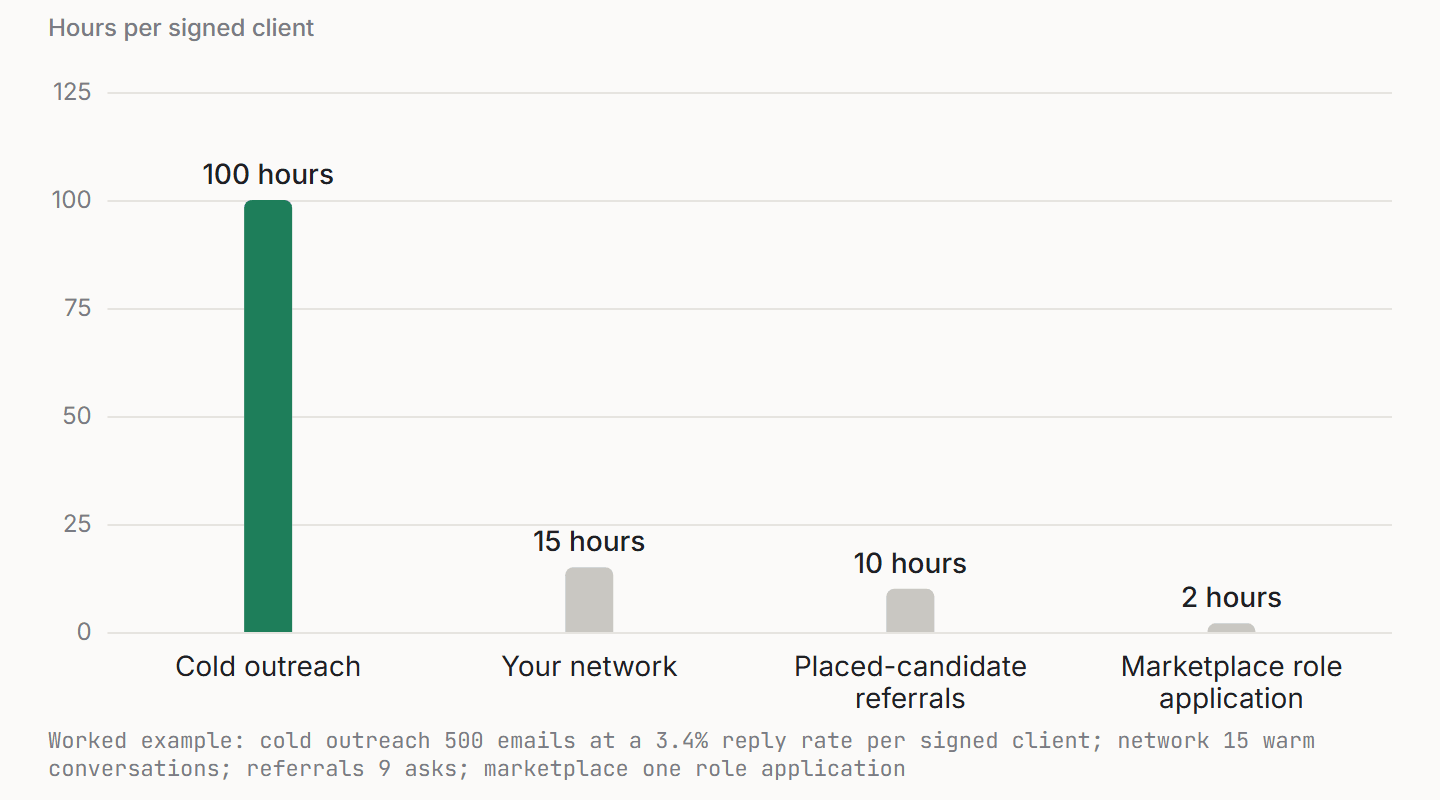
Four ways, and they differ by fifty times in hours. Cold outreach costs a new independent about 100 hours per signed client. A warm network costs about 15, referrals from placed candidates about 10, and a marketplace role application about 2, because there the client step is an application rather than a pitch.
How independent recruiters get clients
Every guide lists the same paths, so I will cost them instead of listing them. The unit that matters is hours per signed client: the time between deciding to find a client and holding a signed fee agreement with a live role on it. The agreement is the finish line, because a hiring manager who likes you and has no open role is a coffee, not a client.
| Path | Hours per signed client | What you keep of the fee | What it needs |
|---|---|---|---|
| Cold outreach | About 100 | All of it | A list and five weeks |
| Your network | About 15 | All of it | Hiring managers who take your call |
| Placed-candidate referrals | About 10 | All of it | A placement first |
| Marketplace role application | About 2 | Less the platform's share | Approval, which is capped |
The hours are my estimates for a first-year independent, and the arithmetic behind each is below. The ratios are the point. Referrals and warm introductions cost a tenth of cold outreach, and a marketplace cuts the client step to a couple of hours by charging for it instead of letting you pay in time.
Cold outreach is the most expensive line on the desk
The standard advice is that clients come from your network and from a hundred cold emails a week: pick a niche, post on LinkedIn every day, keep dialing until the orders come. Manatal's guide for independent recruiters puts it plainly: start with your existing network, then lead cold outreach with a specific role and a most-placeable candidate. The niche part is right. The hundred emails are where I want to do the arithmetic.
Cold email gets a reply about 3.4% of the time in 2026, per Woodpecker's statistics from over 20 million sends, down from 5.1% in 2024. Lists under 50 people do better, at 5.8%, and sequences with three to five follow-ups reach 8.3%. A new independent with no list and no name is at the average on a good week.
So run it. To sign one client from cold, assume 500 emails at 3.4% for 17 replies, one reply in four turning into a real conversation, and one conversation in four signing, because you are a stranger with no track record.
Each contact takes about 10 minutes to research, write and follow up three times, so 500 of them is 83 hours. Add about 15 hours for the four conversations, the proposals that follow and the agreement back-and-forth, and you are at about 100 hours per signed client. At the consensus pace of 100 emails a week, that is five weeks, with about 17 hours of each spent on the emails alone.
Now put a placement beside it. One role at a $155,000 base and a 22% fee is $34,100. Top Echelon's 2019 training ratios put the contingency target at three job orders per placement and the industry average at eight, which is another way of saying most signed orders never pay.
Three signed clients from cold is 300 hours before the first hour of search: $114 of fee for each hour of selling, if every assumption holds. At the industry average of eight orders it is 800 hours and $43. Double the reply rate with small lists and follow-ups and the target case is 150 hours and $227. Either way, selling is the most expensive line on the desk, and the one the guides price at zero.
Your network, and what to do when it is a company badge you handed back
The network path is the cheap one, when it exists. Fifteen warm conversations at about an hour each, counting the scheduling and the follow-up, and in my experience one of them signs this quarter: about 15 hours per client, and the client already trusts you. The recruiters who say clients just come from the network are telling the truth. They had one before they went independent.
The trap for an in-house recruiter is that the network was the badge. Your hiring managers took your call because you were their recruiter, and the day you left, someone else was. A few will hire you as an outside recruiter and most will not, because the company that let you go still has an internal team and a rule about agency spend.
Count the hiring managers who would take your call this week. Under ten, and the network path is not yours yet.
The move is narrower than a template: write to the twenty people who know your work, not the two hundred who know your name, and ask who is hiring rather than whether they are. A former hiring manager who has since moved companies is the best lead on the list: the trust came with them and the agency-spend rule did not.
Placed candidates as the referral engine
Every placement creates two warm contacts you did not have: the person you placed, now inside a company with a hiring plan, and the manager who hired them, who now has proof. Manatal's guide suggests following up at the end of the guarantee period and asking for a referral to the client's next open role. I would ask at day 30, while everyone still remembers, and I would ask the candidate as well as the manager.
The arithmetic is kind. Say one ask in three produces an introduction and one introduction in three signs. That is nine asks per client, at about an hour each with the follow-up: about 10 hours, and the conversation opens with someone vouching for you. After five placements you have ten people to ask, and the desk starts feeding itself.
The catch is the order of operations. Referrals need a placement first, and a placement needs a client first, so this path cannot start the desk. It is what makes year two cheaper than year one, provided year one's placements stick.
The marketplace path, where the client step is an application
On Chosen the client step is a role application. Companies post roles with the fee and comp band published, approved recruiters pick from the board, and a person reviews an application usually within a business day. You never pitch, negotiate with or invoice the client; Chosen does. Reading the brief, the notes the hiring team wrote for recruiters and the intake summary when one has been published, then applying, takes about two hours. Chosen keeps 20% of the placement fee and the placing recruiter keeps 80%, on every role.
Four limits. The approval cap keeps live roles ahead of recruiters, so the application is not a formality, and good recruiters land on the waitlist when roles are scarce. Chosen is small, 13 approved recruiters in September 2026, and it publishes no placement stats. The roles skew to US startups: engineering, product and GTM, with some design and finance.
And a role on a board usually has other recruiters on it, where your own client might have only you, so expect roles per placement to sit nearer Top Echelon's eight than its three. Nobody publishes that figure, this board included.
Whether the trade is good depends on what your selling hour is worth. On the $155,000 role at 22%, the $34,100 fee pays you $27,280 and the board keeps $6,820. From cold, that $6,820 buys back about 98 hours, roughly $70 an hour, which is cheaper than almost anyone's time. From a warm network it buys back about 13 hours, over $500 an hour, a bad trade unless the network has run dry.
The mix I would run in year one
Take the count of hiring managers who would take your call this week, and pick the plan for your number.
Ten or more: run the network first, ask for referrals from day 30 of every placement, and use a marketplace for the roles your people are not hiring for. Your client step costs about 15 hours and you keep the whole fee.
Fewer than ten, which is most in-house recruiters the year they leave: start on a marketplace, because two hours per role is the only client step that fits inside a search week, and build the referral engine from the first placement.
Keep cold outreach, but aim it at ten companies where you know something a stranger does not, put a specific candidate in the first line, and cap it at four hours a week. A hundred emails a week to strangers is the plan that costs 100 hours a client, and it is the plan the guides hand to the people least able to afford it.
Cost your client step in hours before you pick it, and put the hours you save into the search.
Questions people ask next
How do I get job orders without cold calling?
Three ways that do not start with a stranger. Hiring managers who already know your work, referrals from the candidates you placed and the managers who hired them, and a marketplace where the role arrives with the fee and comp band published and the client step is an application. Cold outreach comes last, capped at four hours a week.
How long does it take a one-person agency to land its first client?
Weeks with a warm network, months from cold. At 100 emails a week and a 3.4% reply rate, my arithmetic gives about five weeks per signed client, and the first one usually takes longer. On a marketplace, a role application is reviewed usually within a business day once you are approved, and approvals are capped.
Are there platforms that hand recruiters live roles with the fee already agreed?
Yes. On Chosen the company sets the fee when it posts the role, and you see the comp band, your rate and your dollars at both ends of the band before you apply. The board is small, 13 approved recruiters in September 2026, and Chosen keeps 20% of the fee. Other platforms publish their own terms.
Sources
- Cold email statistics based on sending over 20 million cold emails, Woodpecker. Accessed Sep 30, 2026
- 4 recruitment ratios to earn more revenue as a search consultant, Top Echelon. Accessed Sep 30, 2026
- How to be an independent recruiter and get clients, Manatal. Accessed Sep 30, 2026
- Marketplace guide, Chosen. Accessed Sep 30, 2026