Recruiting agencies that only charge when you hire
Contingency recruiting is the normal model and costs $0 until someone starts; the catch lives in five lines of the agreement, so read those before you sign.

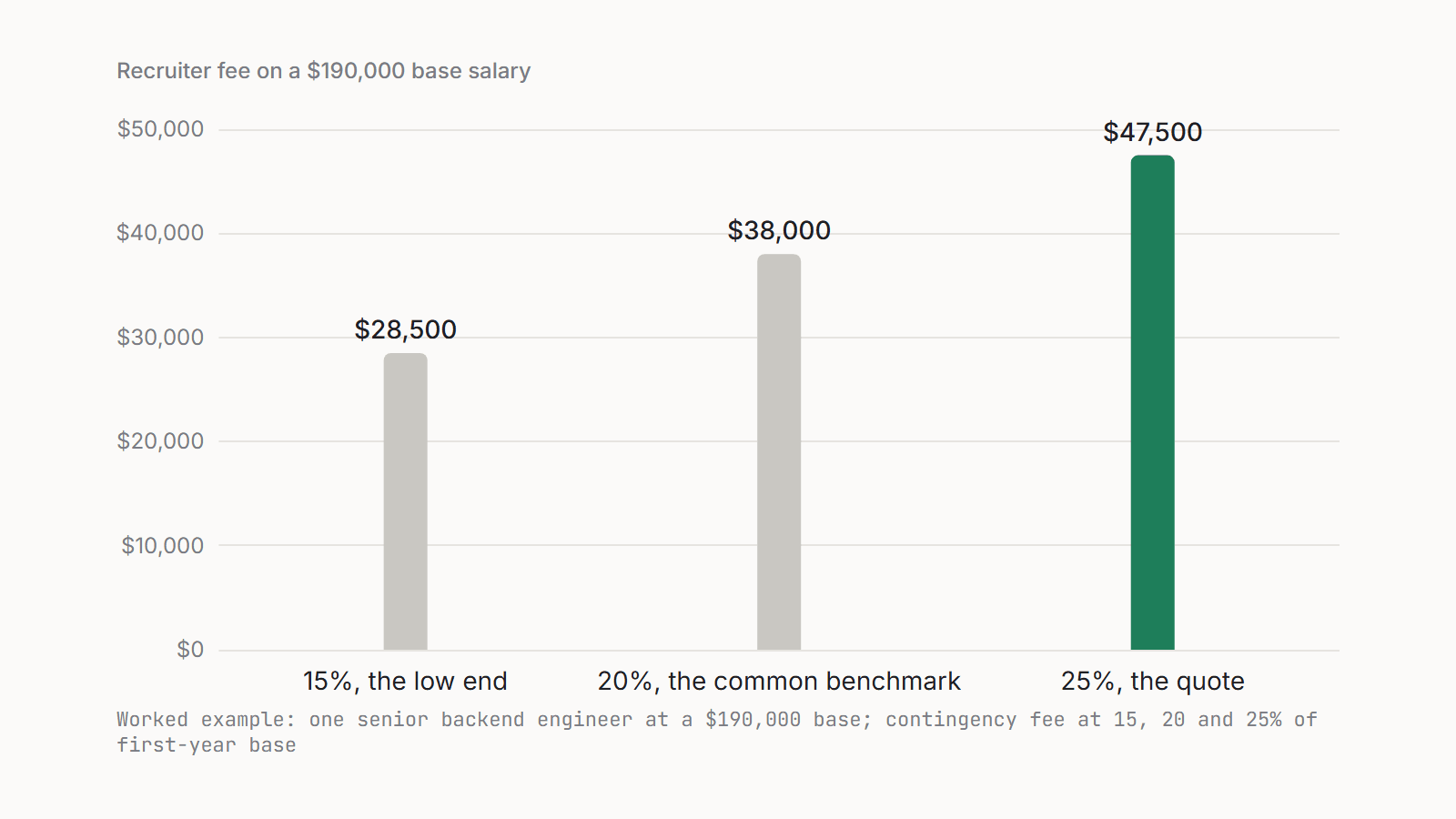
Yes, and it is the default. Contingency recruiting charges nothing until someone starts, then a percent of first-year salary, 15 to 25% per Dover's explainer on fee agreements. On a $140,000 engineer at 20% that is $28,000, invoiced when the hire starts and $0 before that. The model is fine. Five lines in the agreement are where it goes wrong.
Agencies that only charge when you hire
An agency that only charges when you hire, with no retainer, is running contingency, and contingency is most of the industry. The agency sources, screens and submits at its own cost. If you hire its candidate you owe a fee; if you do not, you owe nothing.
Dover's explainer puts most tech agencies between 15 and 25% of first-year salary. Leonar's guide to agency fees gives the same range on first-year base and calls contingency the most common model. HeroHunt's write-up on Paraform reports 20 to 25% for that marketplace, paid the same way.
So you do not need to hunt for a special kind of agency. You need to read the agreement the normal kind sends, because the money that is not in a retainer has to live somewhere, and it lives in the definitions.
Free of cash is not free of cost
The standard advice for a small company is that contingency is the safe choice: no retainer, no exposure, nothing to lose if the search stalls. The cash part is true, and it matters when you have eight people and a runway. I would still push back on "nothing to lose".
Start with attention. A recruiter on contingency works several roles at once, because most of them will never pay, and gives each role a share of the week in proportion to how likely it is to pay. A hard role's share shrinks the moment an easier one lands on the desk. Nobody tells you; the submissions just slow down. A retainer buys the whole week. No retainer buys a slice of it, and the slice is the agency's to resize.
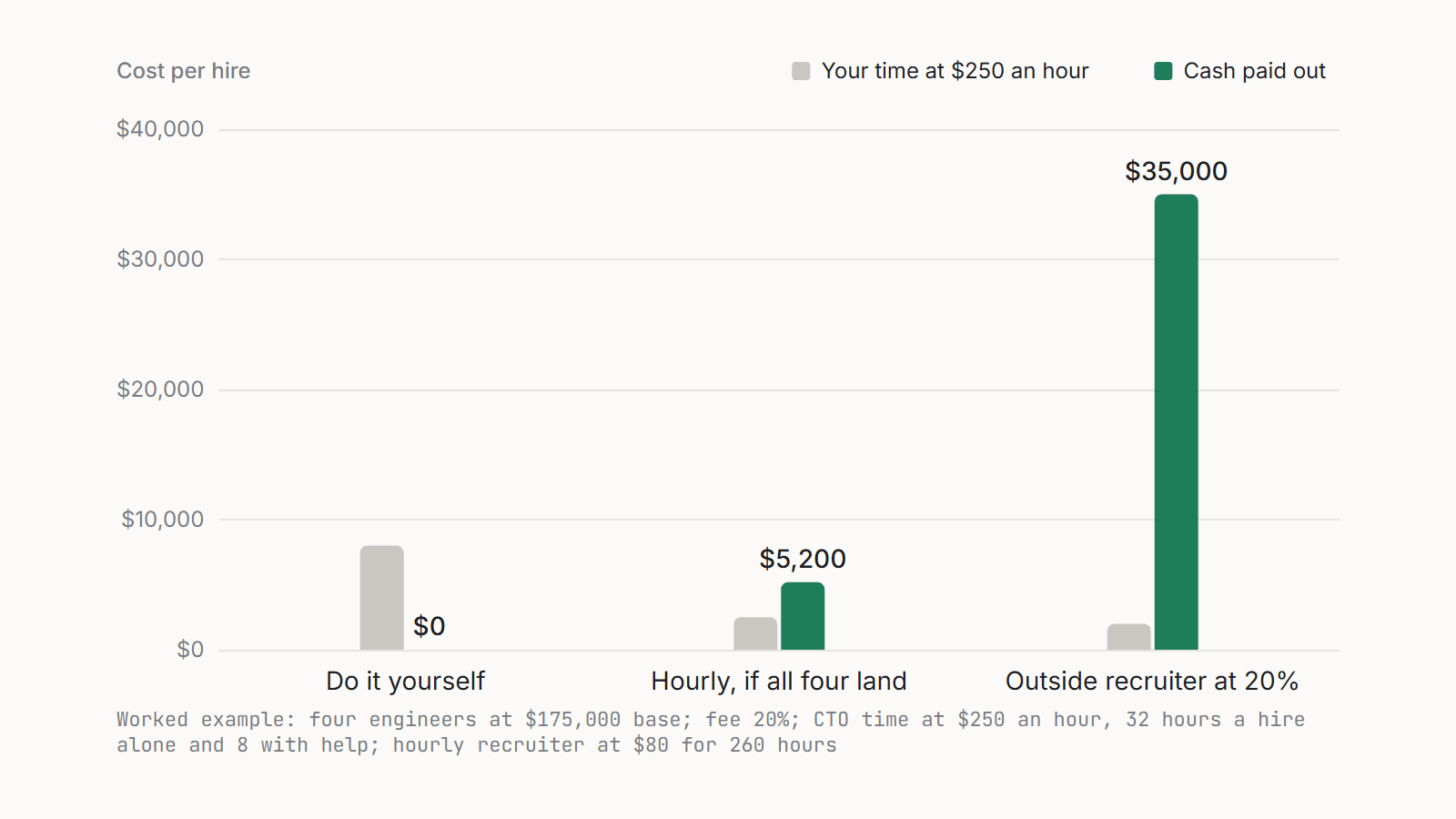
Then the price. Dover's pricing page prices its marketplace recruiters by the hour, cost per hire being hours times the recruiter's rate, and HeroHunt reports about $80 an hour. At $80 an hour a $28,000 contingency fee is 350 hours, and no search for a mid-level engineer takes 350 hours.
Most of the fee is the price of the searches that did not close and of your right to walk away owing nothing. Insurance, in other words, and insurance is expensive when the risk is low.
Then the paperwork, which is the part the advice skips. The agency's only protection in a no-retainer deal is the agreement, so the agreement is written to protect the agency. What the percent applies to, how long they own a candidate, what happens if you find the person elsewhere, when the invoice is due. None of that costs cash today. All of it can cost $5,000 later, and the five lines below show where.
What contingency means on a $140,000 hire
Take a mid-level engineer at a $140,000 base and a 20% fee.
| When | What happens | Cash out |
|---|---|---|
| Day 0 | You sign; the agency starts | $0 |
| Weeks 2 to 6 | Submissions, interviews, one offer | $0 |
| Day 45 | Offer accepted; notice period begins | $0 |
| Day 75 | The engineer starts; invoice for $28,000 | $0 |
| Day 105 | Invoice due, 30 days after the start | $28,000 |
| Day 165 | Guarantee ends, 90 days after the start | $0 |
Dover's explainer describes invoices due within 30 days of the start date, and 90 days as the typical guarantee. If the engineer leaves in week six, the agency either refunds part of the fee or runs the search again; which one depends on line four below. If the search stalls in week eight and you hire a referral instead, the total is $0, which is the whole appeal.
Hourly help runs the other way. At $80 an hour, 60 hours of a fractional recruiter's time is $4,800, spent by day 45 whether or not the offer lands. That is the trade. Hourly is cheaper when the search works and costs more when it does not; contingency charges you nothing for the failures and more for the success.
The five lines to read before you sign
Every no-retainer agreement I have read puts its money in the same five places.
| Line | Ask for | Where the money hides |
|---|---|---|
| 1. Fee basis | A percent of first-year base salary | "Total compensation" adds bonus and sometimes equity |
| 2. Ownership window | 6 months, a named list, the same role | 12 months on anyone the agency ever contacted |
| 3. Exclusivity | None in a contingency deal | Your own referral owes a fee during the window |
| 4. Guarantee | 90 days, with a refund option | 30 days, replacement only |
| 5. Payment timing | Due after the start date | Due at offer acceptance, with late fees |
Line one moves the most money, and it is the shortest. "20% of first-year base salary" and "20% of first-year compensation" look identical at a glance. A percent of base rises with the salary; a percent of compensation rises with every bonus too. On a $140,000 base with a $10,000 signing bonus and a $15,000 target bonus, the first is $28,000 and the second is $33,000. That is $5,000 for one word.
Line two is the hired-later window, sometimes called candidate ownership. Leonar's guide describes windows of 6 to 12 months and recommends a named list of the candidates actually presented, rather than a blanket right to anyone contacted, with the window negotiated down, to 90 days if the agency will take it. Dover's explainer asks for 6 months instead of 12 and no fee when the candidate is hired for a different role. Both are right.
A blanket window means an engineer the agency emailed once in March and you met at a meetup in October costs $28,000.
Line three should not be there at all. Exclusivity in a contingency deal means the agency has moved the risk back to you while keeping the contingency price. If an agency insists, Dover's explainer calls 15 days to prove delivery fair and 30 days reasonable; anything past 45 needs a reason. Your own inbound and referrals stay outside it, in writing.
Line four is the guarantee. Leonar's guide puts the usual one at 60 to 90 days; ask for 90, and for the choice between a replacement search and a prorated refund, because a replacement-only clause with an agency that has gone quiet is worth nothing.
Line five is timing. The fee is earned when the person starts, not when they accept, since an accepted offer is not a hire. Leonar's guide notes that paying within 10 days of placement often buys a 1 to 3 point discount, which on this hire is $1,400 to 4,200. Take that trade, and take it in writing.
The fees that hide inside a no-retainer deal
A retainer does not always call itself a retainer. Watch for:
- an engagement fee "credited against the placement fee", which is a retainer with a nicer name
- a listing or posting fee to put the role in front of recruiters
- a monthly platform subscription that runs while the role is open
- hourly sourcing support invoiced alongside the placement fee
- an administration charge on the invoice
The test is simple: any money that leaves before someone starts is a retainer, whatever the line item says.
On Chosen the five lines are short. The fee is a percent of the hire's first-year base salary, and the company sets it when it posts the role. No listing fee, no subscription, no retainer, no exclusivity; you keep your own pipeline and can fill the role from any source. A person at Chosen reviews each packet before you do. Nothing is owed while a role stays open or after a lost offer; one invoice arrives when the hire starts.
Not all five are published on Chosen today, and I would rather say so than guess. Payment terms beyond that one invoice sit in the agreement and are not published. A replacement guarantee applies after the hire starts; its period, remedy and exclusions are not published, so confirm the current terms with a founder before you sign. No hired-later clause is written for companies; ask a founder how a later hire is handled.
Ask for base, 6 months, no exclusivity, 90 days and payment after the start, then sign.
Questions people ask next
Red flags when picking a recruiting agency, like 90 days of exclusivity and a $5,000 retainer?
Both move the risk back to you while keeping the contingency price. A retainer is paid whether or not anyone starts, and 90 days of exclusivity means your own referrals owe a fee for a quarter. Dover's explainer calls 30 days reasonable; anything past 45 needs a reason. Chosen asks for no retainer and no exclusivity.
When is a recruiter fee actually due, at offer, at start date, or after probation?
The start date is the norm, with the invoice due about 30 days after it. At offer is a red flag, because an accepted offer is not a hire. After probation is rare. On Chosen the fee is owed when the placed candidate starts and is invoiced once; terms beyond that sit in your agreement.
What's a normal guarantee period on a contingency placement?
60 to 90 days is usual, and the shape matters more than the length: a refund, a prorated refund, or a replacement search only. 30 days is short for a $40,000 fee. Chosen gives a replacement guarantee after the hire starts, but its period, remedy and exclusions are not published; confirm the current terms with a founder before you sign.
Sources
- Recruitment fee agreements and the clauses to negotiate, Dover. Accessed Sep 30, 2026
- How much do recruitment agencies charge, Leonar. Accessed Sep 30, 2026
- Paraform pricing and alternatives 2026, HeroHunt. Accessed Sep 30, 2026
- Dover pricing, Dover. Accessed Sep 30, 2026