Is 25% of first-year salary a normal recruiter fee?
Yes, at the top of the usual 15 to 25% range; $47,500 on a $190,000 engineer is market, and each point you move the percent is worth $1,900 on this hire.
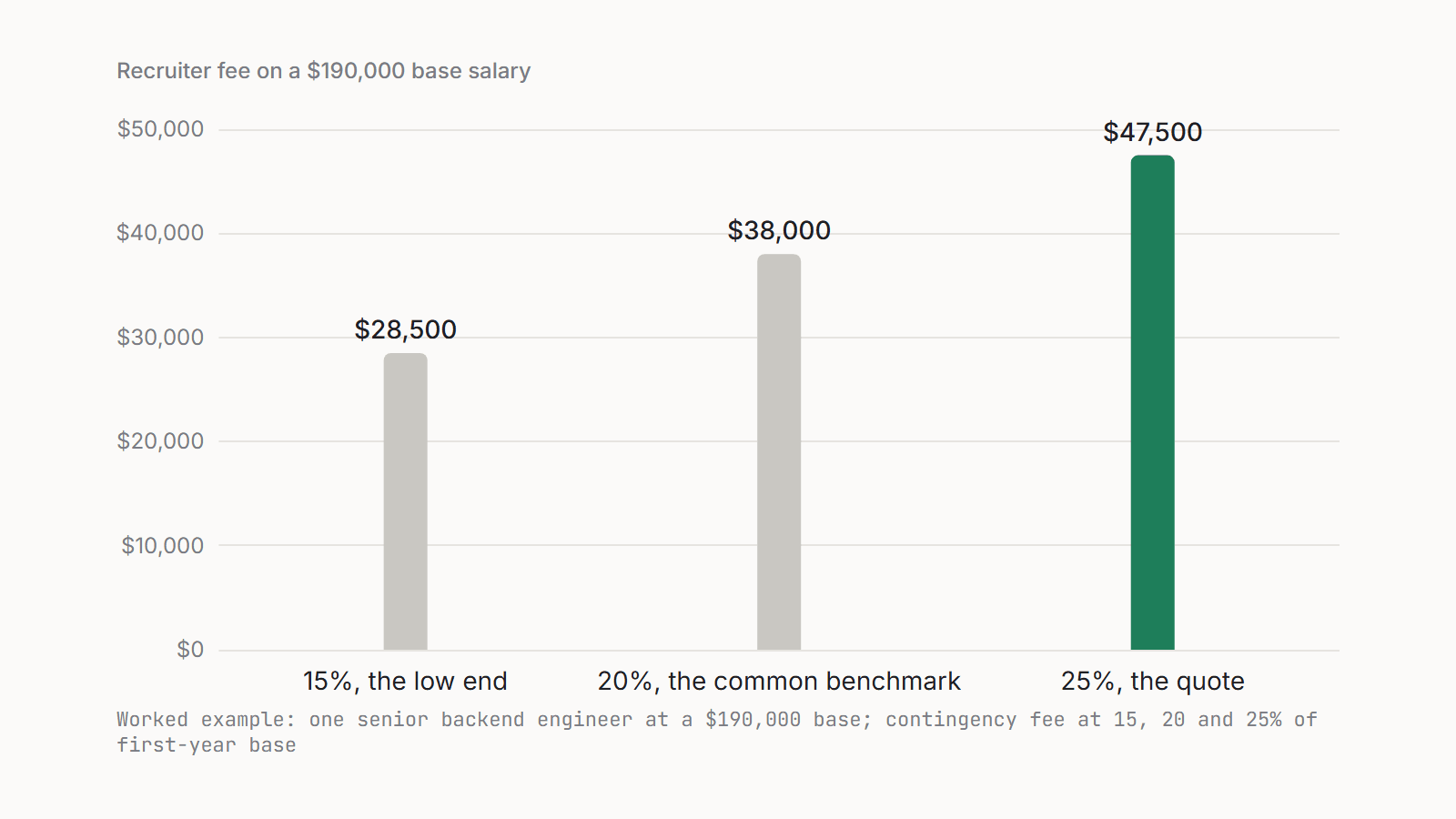
Yes. A 25% fee is the top of the normal range. Pin's 2026 guide to agency commissions, citing SHRM, puts contingency fees at 15 to 25% of first-year salary, with 20% the most common. On a $190,000 base that is $28,500 at 15%, $38,000 at 20% and $47,500 at 25%. Each point is worth $1,900 on this hire.
Is 25% a normal recruiter fee
Two more sources say the same thing from different angles. Dover's explainer on fee agreements says most tech agencies charge 15 to 25% of first-year salary, rising to 20 to 30% for executive roles. HeroHunt's 2026 write-up on Paraform puts the wider industry at 15 to 30%, typically landing at 20 to 25%, and Paraform's own reported fee at 20 to 25%.
So 25% is the ceiling of normal for an individual contributor and the middle of normal for an executive search. A senior backend engineer is the first kind. The agency did not invent the number. They quoted the top of the band and waited to see whether you knew where the band was.
Check one thing before you argue about the percent: what it is a percent of. Every source above says first-year salary, and the good agreements mean base. Some mean base plus signing bonus plus target bonus, which on a $190,000 engineer with a $20,000 bonus turns 25% into $52,500. Get the basis in writing before the percent conversation starts.
The fee prices the agency's overhead, not the recruiter
The consensus, from HR blogs to the agency's own pitch, is that 25% is what a good technical recruiter costs and that you get what you pay for. There is a real truth at the bottom of it. Below the market range, good recruiters stop picking up, because your role pays less than the others on their desk for the same work.
Above that floor, the percent stops measuring the recruiter and starts measuring the firm. The person who will actually call your candidates sees a fraction of the fee. Pin puts the placing recruiter's cut at 20 to 30% of fee revenue at a contingency agency; HeroHunt describes a traditional firm's split as roughly half.
The rest pays for the account manager, the business development, the office and, above all, the searches that never closed. Contingency is a numbers game. The firm works several roles it will never fill, and each fee that lands carries the ones that did not.
So the 25% measures the agency's fill rate and cost base. The recruiter on your role is not in the number. Here is the test. Take the same recruiter, the same list and the same phone. At 20% they submit the same three people they would have submitted at 25%.
Nothing about the candidates changes; the only thing that changes is $9,500 on this hire. A percent that moves by $9,500 without moving the candidates is a price, not a grade. Set the price from the market range yourself, and grade the recruiter on the first three candidates they send.
What each point is worth on $190,000
The arithmetic is the useful part, so here it is in full. One point of fee on a $190,000 base is $1,900.
| Fee | On a $190,000 base | Against the 25% quote |
|---|---|---|
| 15% | $28,500 | $19,000 less |
| 18% | $34,200 | $13,300 less |
| 20% | $38,000 | $9,500 less |
| 22% | $41,800 | $5,700 less |
| 25% | $47,500 | the quote |
The gap between the quote and the most common fee is $9,500, about two and a half weeks of the engineer's own salary. It is also the entire negotiation. Nobody moves from 25 to 15 on a senior role. The conversation lives between 20 and 25, and every point of it is $1,900 you either keep or hand over on the day the person starts.
Keep the table in your head during the call, because the agency will talk in points and you should hear dollars. "We can do 23" is $43,700. "Our standard is 25 but we will honour 22 for a second role" is $41,800 on this hire and a promise about the next one.
What $47,500 buys and what it does not
Start with what it does not buy, because that is the part the pitch skips. It does not buy the interview loop; that is still your team's afternoons. It does not buy the decision.
It does not buy a filled role, since a contingency agency can go quiet on a hard search and owes you nothing when it does. And it does not buy the candidate's attention, because the same person may be talking to two agencies and answering a job post at the same time.
What it buys is the search and the risk. The search is the part you never see: call it 200 profiles nobody on your team read, 40 first messages and 10 screening calls, then the scheduling, the reference calls and the close, including the week the candidate's current employer counters.
The risk is what explains the price. At the $80 an hour HeroHunt reports for Dover's fractional recruiters, $47,500 is nearly 600 hours of recruiting. Nobody spends 600 hours on one search. The fee is a price for risk, not for hours: if the search fails you owe nothing, and that right is built into the 25%.
It also buys a guarantee, usually. Dover's explainer gives 90 days as typical, in three shapes: a full refund, a prorated refund, or a replacement search with no money back. The shape matters more than the days, and the right shape is worth a point of fee.
Where 25% is fair and where it is not
It depends on four things, and you can check all four in one call.
| Check | 25% is fair when | 25% is not when |
|---|---|---|
| The role | A niche stack, a staff level, a small market or a location lock | A mainstream senior backend role in a large hub with decent inbound |
| The basis | The percent is on base | The percent is on total compensation |
| The terms | Contingency only, no exclusivity, no retainer | Exclusivity or a retainer is bundled in |
| The guarantee | 90 days, refund or replacement, in writing | 30 days, or nothing in writing |
The terms row is the one people miss. A 25% contingency fee is priced for the agency carrying the risk of a failed search. If the agency also wants exclusivity or a retainer, the risk has moved to you, and the fee should fall with it. Do not pay for the same risk twice.
My recommendation for the engineer in the question: counter at 20% on base with the guarantee in writing and no exclusivity. Go to 22 if the agency can show you the search is genuinely hard. Pay 25 only for a market you cannot reach yourself.
Setting the percent yourself
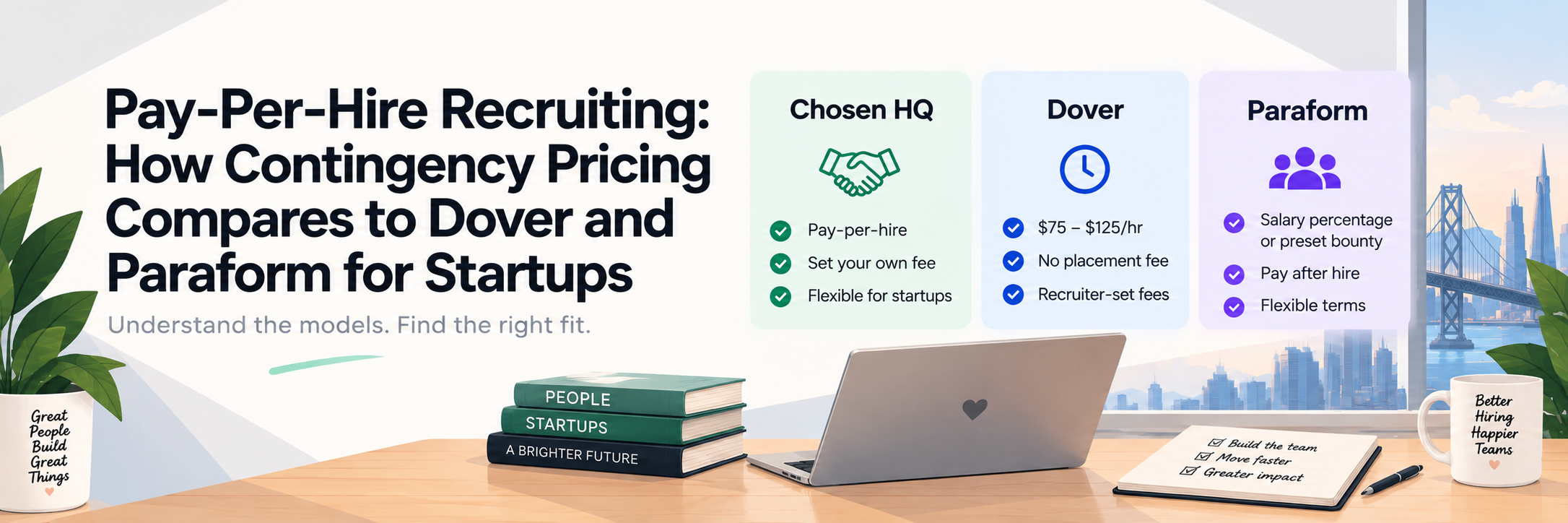
The other way to land on a number is not to be quoted one. On Chosen the company sets the fee when it posts the role, as a percent of the hire's first-year base salary, so it rises with the salary. The publish wizard suggests 20% and tells you most roles land between 15 and 25%. Once a role is published the fee can be raised but never lowered.
The fee is owed once, when the hire starts, and Chosen keeps 20% of the placement fee and the placing recruiter keeps 80%, on every role. Two limits before you weigh that against the quote. Chosen is small: it had 13 approved recruiters in September 2026 and publishes no placement stats yet. Chosen does not guarantee that any role will be filled, and neither does the agency that quoted you 25%; they just leave that out of the email.
Counter at 20% on base, get the guarantee in writing, and keep the $9,500.
Questions people ask next
Can I negotiate a recruiter's fee down from 25%? What's realistic?
Usually, and 20% is the realistic landing spot for a senior engineer. Agencies move for something they value: a second role, a fast interview loop, a decision within a week of each candidate. Below 15% the good ones stop answering. On Chosen you set the percent when you post, and once published it can go up but never down.
Why do recruiters charge a percentage of salary instead of a flat fee?
Because the percent prices the search and the market at once: a harder, more senior role pays more without a new negotiation. The inflation worry is smaller than it looks. Pushing an offer from $190,000 to $200,000 earns the agency $2,500 more at 25% and costs you $10,000 a year. Recruiters are paid for the close, not the raise.
How much does it actually cost to hire one engineer at a startup, all in?
The fee is the biggest line, not the only one. On a $190,000 hire at 20% the fee is $38,000. Add a few hundred dollars a month in tools and 30 to 60 hours of your own time for calls, interviews and the close. No vendor removes the hours; a recruiter removes the sourcing that sits in front of them.
Sources
- Recruitment agency commission structures explained, Pin. Accessed Sep 30, 2026
- Recruitment fee agreements and the clauses to negotiate, Dover. Accessed Sep 30, 2026
- Paraform pricing and alternatives 2026, HeroHunt. Accessed Sep 30, 2026