Hire a recruiter, use an agency, or keep doing it yourself
A recruiter takes six to eight weeks to hire and longer to ramp, so four engineers by Q1 comes down to your own hours or a fee at each start date.
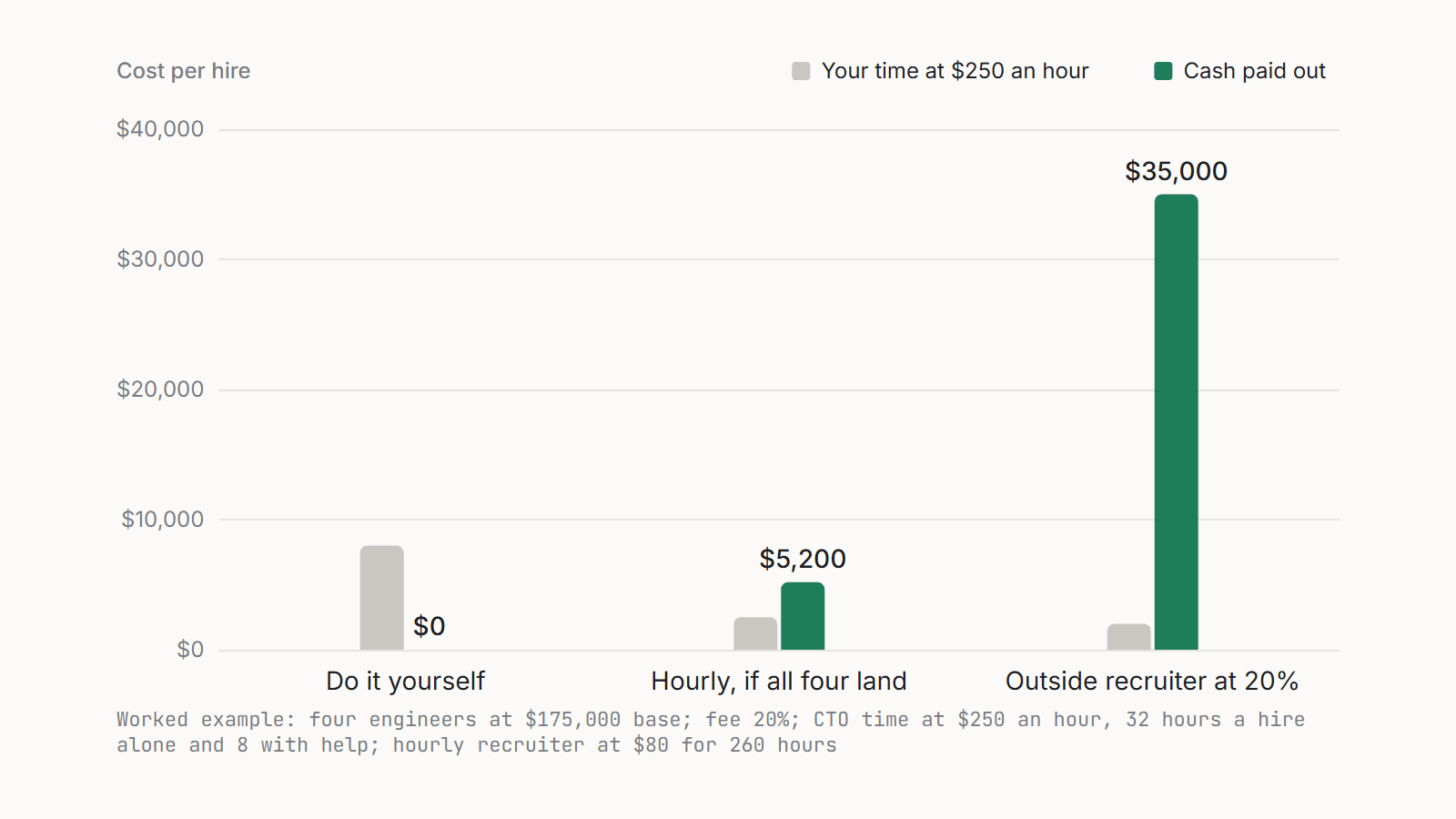
Keep doing it yourself for the roles you can give 32 hours each, and put pay-on-hire recruiters on the rest from day one. The in-house recruiter is off the table this quarter: hired today, the recruiter starts around week eight and ramps into Q1. Four hires at $175,000 and 20% is $140,000 in fees, or about 130 CTO hours.
Hire a recruiter, use an agency, or keep doing it yourself
Three paths, three cost shapes. An in-house recruiter is a salary whether or not you hire. An agency is a fee whether or not the search was hard. Doing it yourself is hours, and at 12 people they are the CTO's hours, which is why you are the one asking.
Here is the example I will use throughout. Four engineers at a base of $175,000. Twelve people, one CTO, no talent function. I am reading "by Q1" as four people at desks when Q1 opens, which gives you 13 weeks from the day you read this. If you meant the end of Q1 you have 26, and I come back to that below.
| Path | Paid before anyone starts | Paid at each start | Your hours per hire |
|---|---|---|---|
| Do it yourself | $0 | $0 | About 32 |
| A recruiter by the hour | About $20,800 over the quarter | $0 | About 10 |
| An outside recruiter on a fee | $0 | $35,000 at 20% | About 8 |
| An in-house recruiter, hired today | About $10,000 of salary before Q1 | $0 | 20 for that search, then none before Q1 |
The second row is one the question did not ask about, and it matters, because renting hours is the only way to get a recruiter's hours before Q1. Dover sells its recruiters by the hour, on a retainer or per hire, and says finding one takes one to two days.
The hourly rate runs about $80, per HeroHunt's July 2026 write-up. Twenty hours a week for 13 weeks is $20,800, which is $5,200 a hire if all four land and $10,400 a hire if two do. The hours are on the invoice either way.
The last row is the one most advice tells you to pick, so it gets its own section.
The recruiter you start hiring today lands after Q1
The standard advice is that once you have more than two open roles you hire an in-house recruiter, because four agency fees would pay a year of salary. The money part is right. Four fees at $35,000 is $140,000.
A startup technical recruiter runs about $110,000 in base and about $130,000 loaded, in my experience, and that is not a low estimate: the Bureau of Labor Statistics puts the median human resources specialist at $75,940 a year as of May 2025, and the recruiter who closes senior engineers for a company nobody has heard of sits well above that median. On salary alone, four hires a year pays for the seat.
Here is where the calendar takes over. Hiring one is a search like any other, and it runs on the same clock as the four you are trying to fill.
| Week | What happens |
|---|---|
| 1 | Write the role, post it, tell your network |
| 2 to 4 | Applicants, outreach, screening calls |
| 4 to 6 | Interviews with you and a founder |
| 6 to 7 | Offer, references, the notice period starts |
| 8 to 10 | The recruiter starts |
| 10 to 14 | Ramp: your roles, your bar, your calendars, four pipelines from zero |
Six to eight weeks to an accepted offer is a normal outcome, in my experience, when nothing goes wrong. Then two to four weeks of notice, then a month of ramp, because a recruiter's first month anywhere is spent learning what "senior" means to you, and the first engineer's notice period sits on top of all that.
Hired today, the recruiter's first placement starts around week 16 to 18, a few weeks into Q1. By then three to five weeks of salary, about $10,000, have gone out before Q1 opened and bought no hires. They have not helped with the deadline they were hired for. They will be a fine hire for next year.
If you meant the end of Q1, the recruiter has 26 weeks and can carry one or two of the four, late. The other two or three still come down to your hours or a fee. The search is not the hard part: ERE's 2026 look at talent acquisition careers reports that the BLS count of human resources specialists fell by 5,030 in 2025, its first decline, so good recruiters are answering their phones. The calendar is the hard part.
What four hires cost in CTO hours
Doing it yourself is free in cash and expensive in the one thing a 12-person company cannot buy more of. Here is where 32 hours a hire go when nobody helps, and what is left when an outside recruiter carries the search.
| Work | Alone | With a recruiter |
|---|---|---|
| Lists and first messages | 14 hours | 0 |
| Scheduling and chasing replies | 5 hours | 1 hour |
| Screening calls | 5 hours | 2 hours |
| Technical sessions and the close | 8 hours | 5 hours |
Thirty-two hours a hire, 128 for four, call it 130. At 10 hours a week that is the whole 13-week quarter with no slack, and the slack is not optional, because the hours do not spread evenly. Notice periods sit at the end of the calendar, so the sourcing and the calls have to land in the first nine weeks.
That is 14 hours a week of CTO time, for nine weeks, on top of the product. Most CTOs at 12 people can find 10. Few can find 14, and the ones who try find them after hours, which is where the bar quietly drops.
The 8 hours that stay with you are the ones nobody else can do: the screening call where you judge whether the person clears your bar, the technical session, and the close. A recruiter can find senior engineers and screen them. Only you can make them want the role.
What four hires cost in fees
An agency fee is a percent of first-year base, so it rises with the salary. At 20%, a $175,000 base is $35,000 a hire and $140,000 for four, due as each person starts. At 25%, the top of the usual range, it is $175,000. HeroHunt's write-up puts Paraform's reported fee at 20 to 25% of first-year salary, and the percent is the only number in the deal that moves.
Priced against your time, the fee buys back 24 hours a hire, at about $1,460 an hour. At $250 an hour of CTO time, which is conservative at a funded company, doing it yourself is $8,000 a hire, the fee path is $35,000 plus $2,000 for your remaining 8 hours, and the hourly path, if all four land, is $5,200 plus $2,500 for your 10. On paper the fee loses, four times over.
The catch is the word "can". That comparison only holds for the roles you can fund with 32 hours in nine weeks. For the roles you cannot, $8,000 is a number on a spreadsheet, and the real comparison is $35,000 against a role that is still open in January.
The marketplace version is ours; where an agency proposes the percent, on Chosen you set it when you post the role, the wizard suggests 20%, and most roles land between 15 and 25%. At 18% these four are $126,000, owed as each hire starts, with the ATS free for every role, including the ones you keep. Chosen is small, 13 approved recruiters in September 2026, so keep your network running. Chosen does not guarantee that any role will be filled.
Nothing is owed on a role that stays open, on any pay-on-hire arrangement. That is the whole reason the fee is the right shape for a deadline: the money leaves only when the deadline is met.
The rule I would use at twelve people
Count hours before you count dollars. For each of the four roles, ask whether you can give it 32 hours in the next nine weeks, and answer with the roadmap open.
The roles you can fund, run yourself. Usually these are the one or two closest to what your team already builds, where your network is warm and the first ten messages write themselves. Keep the closing conversations on every role, funded or not.
The roles you cannot fund, post to pay-on-hire recruiters this week, and set the fee where good recruiters will take a hard role. I would set it between 18 and 20% at this stage. A fee nobody will work for is free, and so is the empty desk.
Rent hours only when the open roles outnumber the fees you could stomach, five or more, because the hours arrive on the invoice whether or not anyone starts. With four, I would not.
Put the in-house recruiter in next year's plan, and open the search in January if the plan has eight or more hires in it. On this example's numbers the recruiter costs about four fees a year, and the first year is a ramp, so eight is the number I would want to see before I start.
Count your hours this week, post the roles you cannot fund the same day, and put the recruiter search in January's plan.
Questions people ask next
What are my options for hiring three engineers in two months with no recruiter?
Four. Do it yourself for about 100 founder hours, rent a recruiter by the hour and pay whether or not anyone starts, use an agency at 20 to 25% of first-year base at each start, or use a marketplace where you set the percent. With a hard date, run your network and a pay-on-hire channel from day one.
When does a startup actually need its first in-house recruiter?
When next year's plan has enough hires to pay the salary in saved fees, with a ramp year counted. A loaded $130,000 recruiter against $35,000 fees is about four fees a year on the money alone, and I would want eight planned hires before opening the search. Hires are the trigger, not headcount.
What is a fractional or embedded recruiter and is it better than an agency?
A recruiter you rent by the hour or the week who works inside your process, often found in days. You pay for the hours whether or not anyone starts, so it wins when open roles outnumber the fees you would pay, and loses when one hard role stays open for months.
Sources
- Paraform pricing and alternatives 2026, HeroHunt. Accessed Sep 30, 2026
- Dover recruiters, choose your pricing model, Dover. Accessed Sep 30, 2026
- Human resources specialists, Occupational Outlook Handbook, US Bureau of Labor Statistics. Accessed Sep 30, 2026
- What's happening to talent acquisition careers, 2026 edition, ERE. Accessed Sep 30, 2026