Pay-Per-Hire Recruiting: How Contingency Pricing Compares to Dover and Paraform for Startups
TL;DR
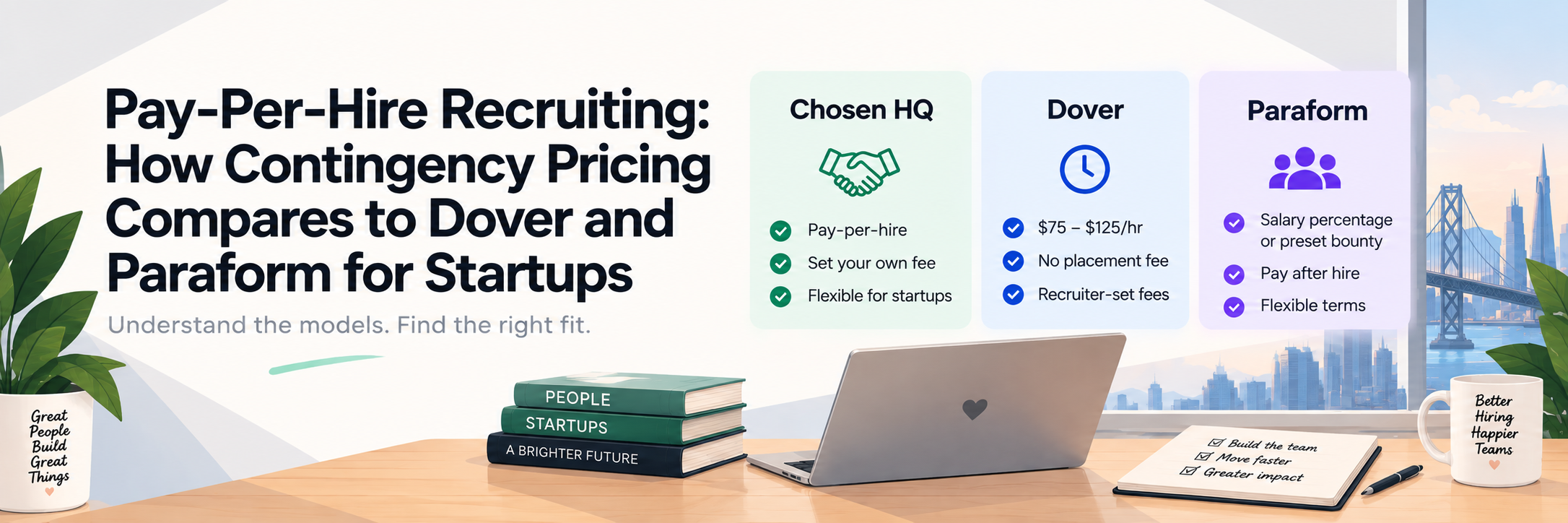
- Chosen HQ and Paraform offer pay-per-hire or contingency recruiting. Chosen HQ lets you set the fee, and Paraform uses a salary percentage or preset bounty. Dover uses hourly recruiting with recruiter-set fees, typically $75 to $125 per hour, and charges no placement fee.
- Pay-per-hire is a contingency model. You pay after a successful hire rather than before recruiters begin working.
- Published estimates place traditional contingency agency fees at 10% to 30% of first-year salary.
- Retained search requires upfront payments and commonly costs 25% to 35% of first-year salary. Startups often skip it when they need to preserve cash or fill routine roles without an advance commitment.
Contingency, retainer, and pay-per-hire: what the terms actually mean
Contingency recruiting charges an employer only after a recruiter places a candidate. Agencies usually charge 10% to 30% of the hire’s first-year salary, with higher fees possible for senior or difficult searches. Because the recruiter receives nothing if another agency fills the role, contingency firms may prioritize candidates they can place quickly.
Retained search charges for dedicated recruiting work regardless of when the employer hires someone. Total fees commonly run 25% to 35% of first-year salary, with payments due upfront and at milestones such as shortlist delivery. The employer usually works exclusively with one search firm, which gives the recruiter more reason to conduct a deeper search.
Contingency search limits the employer’s upfront cost, while a retainer pays the search firm for sustained work regardless of the outcome. One industry comparison reports fill rates of 10% to 25% per contingency agency and 95% to 100% for retained searches. The same comparison estimates an average 39-day time to fill for contingency recruiting, compared with 60 to 180 days for retained search. It also reports that 63% of contingency hires and 82% of retained-search hires remained after one year. These figures vary by role and firm, but they illustrate how exclusivity and paid research can support a more thorough search.
Pay-per-hire recruiting is a form of contingency pricing because payment still depends on a successful hire. The term describes the payment trigger rather than a universal fee formula. A traditional agency generally sets a percentage fee, while some pay-per-hire marketplaces let you choose a fixed fee or bounty when posting the role.
Recruiting marketplaces can coordinate several recruiters through one candidate pipeline. With traditional contingency recruiting, you may hire several agencies separately and manage overlapping candidate submissions. A marketplace can place multiple vetted recruiters on one role while keeping submissions in a shared pipeline. You still avoid upfront recruiting fees, but you gain direct control over the payout and reduce the administrative work created by separate agency relationships.
Which recruiting platforms charge only on successful hire
Chosen HQ and Paraform charge based on a successful hire. Dover uses a different model. Dover recruiters set hourly fees, typically $75 to $125 per hour, and Dover charges no placement fee.
Chosen HQ lets you set the recruiting fee when you post a role. You pay that fee only when the hired candidate starts, and no upfront payment applies.
Paraform operates a contingency marketplace where independent recruiters work on posted roles. According to third-party reporting on Paraform’s pricing, companies choose a percentage-based success fee or a fixed bounty and pay after a successful hire.
Dover pairs companies with fractional recruiting partners who set their own hourly fees. Rates typically range from $75 to $125 per hour. Dover charges no placement fee, but companies pay for recruiter time whether or not the search produces a hire.
Paraform does not publish full pricing details. One third-party comparison estimates Paraform’s success fee at 20% to 25% of first-year salary or a company-set bounty. Dover offers a free ATS and a premium ATS for $199 per month, separate from recruiter fees.
How Chosen HQ's pay-per-hire model works
Chosen HQ lets you set the recruiting fee before you publish a role. Traditional contingency agencies usually charge a percentage of the new hire’s first-year salary. Chosen HQ gives you direct control over the fee, so you know the potential cost before recruiters begin working.
After you post the role, vetted recruiters submit interested candidates who match its requirements. Chosen reviews each candidate before sending the profile to you, which adds a screening step between recruiter submissions and your hiring team.
You manage approved candidates and recruiter communication in Chosen’s free built-in applicant tracking system. The shared pipeline keeps recruiter submissions, communication, and candidate records in one place. You can review progress without switching between agency systems or maintaining a standalone ATS.
Chosen charges no upfront fee. You pay the amount set on the role only when a hired candidate starts work. If the role produces no hire, you owe no recruiting fee.
Chosen HQ vs. Dover vs. Paraform: fee structure, ATS, and vetting
| Category | Chosen HQ | Dover | Paraform |
|---|---|---|---|
| Fee | Set the fee when posting. Pay when the hire starts. | Recruiters set rates of $75 to $125 per hour. No placement fee. | Estimated at 20% to 25% of first-year salary or a company-set bounty. |
| ATS | Free built-in ATS. | Free ATS. Premium plan costs $199 per month. | No included ATS verified. |
| Vetting | Chosen vets recruiters and reviews candidates. | No public vetting method verified. | No public vetting method verified. |
| Pipeline | See recruiter submissions in one pipeline. | Clients reportedly see all contacted talent. | Companies reportedly see submitted candidates only. |
Chosen HQ gives a seed or Series A founder direct control over recruiting spend because the founder sets the success fee before recruiters begin work. Dover removes the placement fee but bills for recruiter time at rates typically ranging from $75 to $125 per hour. Paraform uses a more traditional contingency percentage or bounty, which can produce a much larger fee on highly compensated roles.
Candidate visibility also differs. A commentator with Dover and agency experience describes Dover as providing the full contacted pipeline, while Paraform exposes submitted candidates. Chosen HQ centralizes recruiter submissions and hiring activity in its own ATS.
Founders should confirm Dover’s and Paraform’s current pricing, ATS access, and candidate-visibility terms directly before choosing a platform.
Contingency recruiting agencies vs. marketplace platforms for startups
Traditional contingency agencies and recruiting marketplaces both charge after a hire, but they organize recruiter effort differently. A contingency agency may work on several open roles and earns nothing unless it places someone. Employers often engage several agencies, which creates a race to submit candidates first rather than a coordinated search.
Because an agency receives no fee for an unfilled role, it may limit the time spent on searches that appear less likely to close. One industry analysis estimates that individual contingency agencies fill only 10 to 25 percent of assigned roles and spend about 3.8 hours per vacancy on initial screening. The same analysis reports that 68 percent of contingency recruiters stop working a role after two weeks without a placement. Treat these figures as directional estimates, since they come from an industry source rather than a controlled benchmark.
A marketplace can give you access to several recruiters through one relationship. Chosen HQ places a role before a vetted recruiter network and reviews submitted candidates before you see them. Paraform reportedly lets more than 10 independent recruiters work the same role, while Dover uses a fractional recruiting partner who can manage more of the hiring process.
A centralized marketplace can reduce administrative work for seed and Series A startups that would otherwise manage several agency relationships. You can expand sourcing coverage without signing separate agency agreements or reconciling several candidate lists. A marketplace still needs quality controls because more recruiters can create duplicate outreach and uneven screening. For a founder with limited hiring bandwidth, the useful advantage comes from combining recruiter reach with one managed pipeline.
When performance-based pricing beats a retainer
Choose performance-based recruiting when the role has a reasonably broad candidate pool, your requirements are clear, and preserving cash matters more than reserving one search firm. Published estimates place contingency fees at 10% to 30% of first-year salary after a successful hire. Retained firms usually charge 25 to 35% through upfront and later milestones. Published comparisons estimate about 39 days to fill for contingency searches, compared with 60 to 180 days for retained searches.
A retainer pays a search firm to continue research, outreach, and candidate assessment regardless of whether another source fills the role. Reported fill rates reach 95 to 100% for retained searches, versus 10 to 25% per contingency agency. One-year retention also favors retained hires at 82%, compared with 63% for contingency hires. Executive, confidential, and hard-to-fill specialist searches can justify that added commitment because a narrow candidate pool requires sustained outreach and screening.
Seed and Series A startups hiring individual contributors or common management roles will often favor pay-per-hire or contingency pricing. Chosen HQ lets you set the recruiting fee when posting a role, requires no upfront payment, and charges only when the hire starts. Consider a retainer when the cost of leaving the role open exceeds the upfront fee or when the search requires exclusive access to a small candidate pool.
FAQ
What is contingency recruiting?
A contingency recruiter earns a fee only when you hire the recruiter’s candidate. Traditional agencies usually calculate the fee as a percentage of the hire’s first-year salary.
How much does contingency recruiting cost?
Traditional contingency fees commonly range from 10% to 30% of first-year salary. Chosen HQ lets you set the fee when posting the role, so the cost does not automatically rise with salary.
Is Chosen HQ cheaper than Dover or Paraform?
Chosen HQ costs less when the fee you set falls below Dover’s hourly recruiting total or Paraform’s success fee. Dover recruiters typically charge $75 to $125 per hour with no placement fee. Third-party estimates place Paraform around 20% to 25% of salary or a fixed bounty.
Do I need an ATS if I use a recruiting marketplace?
You still need a way to track candidates, interviews, decisions, and recruiter communication. Chosen HQ includes a free ATS, so you do not need to buy a separate system to manage its recruiter submissions.
What happens if a contingency hire doesn’t work out?
Your contract determines whether you receive a replacement search, a partial refund, or no remedy. Ask Paraform, Chosen HQ, Dover, or any contingency agency to confirm the current guarantee period, eligibility rules, and remedy before you sign.
Get started with pay-per-hire recruiting
Chosen HQ lets you set the recruiting fee before the search begins and charges it only when a hire starts. To evaluate the model for an open role, post the role on Chosen HQ and choose the fee you are prepared to pay.