Contingency vs retained search for a head of engineering
Retained costs 25 to 35% with a third upfront and exclusivity; contingency costs about 20% at the start date and nothing if the search stalls, so pick by risk.

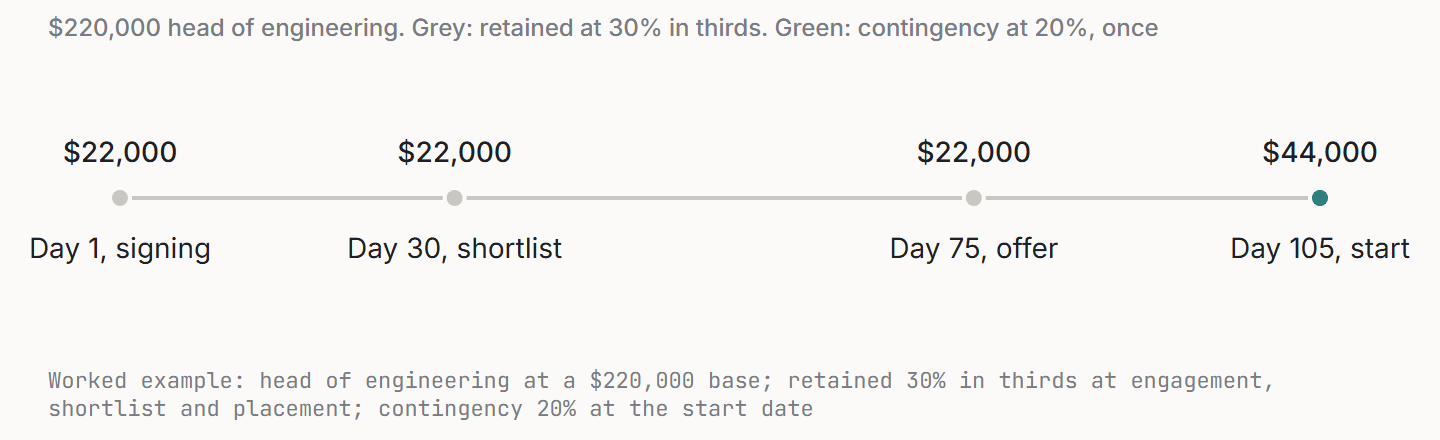
Contingency, usually. Per Pin's guide to agency fee structures, retained search costs 25 to 35% of first-year compensation, a third at signing, hire or no hire; contingency costs 15 to 25% of first-year salary, once, when the hire starts. On a $220,000 head of engineering: $66,000 at 30% on a schedule, or $44,000 at 20% on the start date.
Contingency or retained for a head of engineering
The difference between contingency and retained search is who carries the risk of a search that fails. Under contingency, the agency does. It works the role at its own cost, sometimes alongside two other agencies and your own network, and is paid only if its candidate starts. Leonar's guide to agency fees puts the fee at 15 to 25% of first-year base and calls it the most common model.
Under retained, you do. One firm gets the mandate, usually exclusively, and is paid in three installments. Pin describes them: a third at engagement, non-refundable, a third when candidates are presented, and a third at placement. Leonar's version is the same: kickoff, shortlist and placement. The fee is 25 to 35% of total first-year compensation, base plus bonuses, and Pin notes minimum engagement fees that often start at $80,000 to 100,000.
What you get for carrying the risk is the firm's whole week rather than a slice of it: a market map, a calibrated shortlist by a date, weekly reporting, and a firm on the hook for effort rather than for luck. Whether that is worth $22,000 on day one depends on the search, and the title on the role is a poor guide to the search.
A Series A head of engineering is not an executive search
The consensus is clean: retained for executive hires, contingency for individual contributors, because a leadership search needs a dedicated firm. For a public-company CTO or the quiet replacement of a sitting executive, I agree with it.
A head of engineering at a Series A is a different search. In most of the companies I see, it is the first engineering manager: a senior or staff engineer with a title, reporting to a founder, running 5 to 15 engineers and still writing code on Fridays.
The people who take that role are senior engineers who want to lead, and they live where senior engineers live: in your investors' portfolios, in the networks of the engineers you already have, and on the desks of the same recruiters who fill senior individual contributor roles. Nobody needs a market map of Fortune 500 engineering leadership to find them.
Retained buys a process, and you pay for the process whether it works or not. On this hire that is $22,000 gone at signing and $44,000 gone by the shortlist, before anyone has interviewed.
Read the fee clause too. Some retained agreements earn the fee on any hire made during the engagement, whoever found the person; if yours does, the investor intro that lands your head of engineering in week three costs the full $66,000. On contingency the same intro costs nothing, which is the whole point of a model that only charges for the candidates it found.
What retained costs on a $220,000 hire, and when
Take a head of engineering at a $220,000 base and a retained firm at 30%.
| When | Milestone | Cash out |
|---|---|---|
| Day 1 | Engagement signed | $22,000, non-refundable |
| Day 30 | Shortlist presented | $22,000 |
| Day 75 | Offer accepted | $22,000 |
| Day 105 | The hire starts | $0 |
Total, $66,000, with two thirds of it out the door before an offer exists. If the search stalls after the shortlist, the $44,000 does not come back. If the firm bills on total compensation, which is how Pin describes retained fees, a $30,000 target bonus lifts the fee to $75,000. And if the firm's minimum engagement fee is $80,000, the percent stops mattering and the minimum is the price.
What contingency costs on the same hire
The same hire on contingency at 20% is $44,000, invoiced once, on the start date. Before that, nothing. If the search stalls, nothing. If the offer is declined, nothing. If your own network finds the person, nothing. Two or three agencies on the role still means one fee, to the agency whose candidate starts.
At the leadership end the percent drifts up. Dover's explainer on fee agreements has most tech agencies at 15 to 25% and executive roles reaching 20 to 30%, so a contingency recruiter who takes a head of engineering search seriously may want 25%. That is $55,000, still with zero at risk before the start date, and still $11,000 less than the retained total.
What contingency does not buy is the firm's whole week or a promise of effort. A contingency recruiter rations attention by the odds of a fee, so a leadership role with a long interview loop can drift to the bottom of the desk. A retainer is one fix. A cheaper one is a brief with ranked must-haves, an intake call, a decision on every candidate within a week, and a percent that makes the role worth the week.
When retained earns its money
Retained is the right tool in four situations, and the title of the role is not one of them.
- The search is confidential: a sitting leader is being replaced, or the role cannot be posted, and the approaches have to be quiet.
- The target list is short and named: 20 people could do the role, you can name their employers, and each one needs approaching in order.
- The seat is a real executive seat: a CTO for a company of 200, a board-facing role, a search where the references, the market map and the process are the product.
- You want a firm on the hook for effort, with weekly reporting, and you can afford $44,000 before an offer without flinching.
Two of the four, go retained. One, think about it. None, which is where most Series A heads of engineering sit, contingency.
The Series A answer
Run it contingency. Set the percent where a serious recruiter will work it, 20 to 25% of first-year base, and put two or three recruiters on it. Work your own network and your investors from day one, because that is where this hire usually comes from. If a firm insists on exclusivity, Dover's explainer treats 15 days as a fair trial and 30 as reasonable, with anything past 45 needing a reason, and it never covers your own referrals.
Chosen is contingency. The fee is a percent of the hire's first-year base salary, and the company sets it when it posts the role. The publish wizard's suggestion draws on retained and executive benchmarks as well as similar open roles, so a leadership search can carry a higher percent. There is no retainer and no exclusivity, Chosen may put any number of approved recruiters on the role, and nothing is owed until the hire starts.
Where Chosen does not fit is the retained kind of search. Nobody is on the hook for a market map or a confidential approach, and there are no placement stats to show you. Chosen is small: 13 approved recruiters in September 2026, so it is one source of candidates, not the only one. Chosen does not guarantee that any role will be filled. For a named-target executive search, hire a retained firm and pay the third.
Post the role on contingency at 20 to 25%, call your investors the same day, and keep the $44,000 until someone starts.
Questions people ask next
I need to hire a VP of Sales. Is retained executive search the only option?
No. Retained earns its fee when the search is confidential or the target list is short and named; a startup VP of Sales is usually neither. Chosen is contingency only, focused on startup engineering, product and GTM roles; you can set a higher fee for a senior search, and a founder will tell you whether the recruiter pool fits.
Is it a bad idea to give an agency exclusivity on a role?
Usually. Exclusivity trades your other channels for a promise of effort you cannot measure. If a firm insists, keep it short: Dover's explainer treats 15 days as a fair trial and 30 as reasonable. Chosen does not do exclusivity; approved recruiters compete on your role and you keep your own pipeline.
Is there a recruiting agency that only charges when I hire, with no retainer?
Yes. That is contingency, and it is most of the industry: nothing until someone starts, then 15 to 25% of first-year salary. Before you sign, read the fee basis, the ownership window, the guarantee and the payment timing. On Chosen there is no retainer, no listing fee and no exclusivity, and the fee is owed when the hire starts.
Sources
- Recruitment agency commission structures explained, Pin. Accessed Sep 30, 2026
- How much do recruitment agencies charge, Leonar. Accessed Sep 30, 2026
- Recruitment fee agreements and the clauses to negotiate, Dover. Accessed Sep 30, 2026