How to find companies that will pay a recruiting fee right now
Look for the fee already accepted, not the open role: a posted job ad says nothing about agency budget, and a role with a published fee and track record does.

Look for a fee that is already accepted, in writing, before you do any work. Every other signal is weaker: a job ad, a Series B, a LinkedIn post from the VP of Engineering. On a $175,000 role at 20%, an accepted fee is a $35,000 term in writing; the rest is a conversation you have not had yet.
Finding companies that will pay a recruiting fee right now
Hiring is slow, and the profession knows it. ERE's May 2026 article on talent acquisition careers says the count of HR specialists in the BLS data dropped 0.5% in 2025, the first fall since the bureau's series began in 2012, after 13.6% a year of growth from 2020 to 2022. The companies still hiring are choosier about who they pay to help, and a recruiter's week is spent finding the ones who will.
"Is this company hiring" and "will this company pay a fee" are different questions, and almost all prospecting advice answers the first. A job ad, a funding round and a busy careers page are signals of hiring. A fee is a line in a budget that a finance lead approved, and it leaves few marks on the internet. That is why people prospect on the visible signals, and why the visible signals waste the week.
Everything below is tested on one role: a senior engineer at a $175,000 base and a 20% fee, which is $35,000 when the hire starts.
| Signal | What it proves | What it does not prove |
|---|---|---|
| A job ad | A role exists, most of the time | That anyone will pay a fee to fill it |
| A funding announcement | Cash arrived | That any of it is for agencies |
| A "we're hiring" post | Someone wants attention for the role | That the hiring manager has budget |
A job ad is evidence of a role, not of a fee
The standard advice is to prospect where the hiring is visible. Pin's freelance recruiter guide tells new independents to find targets through careers pages, LinkedIn job posts and press releases about funding, on the grounds that funded companies are almost always hiring. The consensus is right about the hiring. A company with 30 open roles and a fresh Series B is hiring.
I disagree about what the ad tells you. Start with the role itself: Greenhouse's 2024 report on what candidates face says that in any given quarter 18 to 22% of the roles posted on its own platform are classified as ghost postings, advertised with no intent to hire. So an ad is evidence of a role about four times in five. It is evidence of a fee zero times in five, because the fee was never in the ad.
Then the 30 open roles. At $175,000 and 20%, filling them through agencies is 30 fees of $35,000, which is $1,050,000. No finance lead signs that when two recruiters on payroll cost a fraction of it, so the company with 30 open roles is usually the one that stopped paying agencies to fund an in-house desk, and the in-house desk is measured on filling roles without you. The Series B is real; its first hire was the recruiter.
The only signal that pays is a fee accepted in writing before you start: a signed agreement with a percent in it, or a board where the company set the fee when it posted the role. Everything else is a reason to make a call, and no reason at all to start sourcing.
The five signals that budget exists this quarter
Here are the five, in the order I would check them. Each can be checked anywhere by asking, and a board that publishes them saves the asking.
- A fee accepted in writing: a signed agreement with the percent in it, or a role published with the fee set, before you do any work.
- A base salary band: a role with an approved band has been priced by finance, and a role without one is still an idea.
- A track record of paying fees: the date of the last agency hire, and how many days the company took to answer the last submission.
- A hiring manager on the intake: the person with the need spent 30 minutes on the brief, which is the cheapest test of whether the role is real.
- A recent placement: a hire that started in the last quarter proves the process closes, which a job ad never does.
Every role on Chosen comes from a company that accepted a success fee before the role was published. The fee is a percent of the hire's first-year base salary, and the company sets it when it posts the role. A base salary band is required to publish, and the company's track record sits on its profile: marketplace hires, median days to hire and median response days. When there is an intake call, Chosen runs it with the hiring team, records it and publishes a summary.
What a company's track record tells you before you apply
Three numbers tell you most of what a fee agreement cannot. Marketplace hires says whether the company has ever paid a fee here; median days to hire says how long your candidate will sit in the process; median response days says how long a packet waits for an answer. Read together, they separate a company that pays from a company that posted.
Run the two companies. Company A posted the $175,000 role with the fee set at 20%, a band of $160,000 to $190,000, two marketplace hires, a median of 34 days to hire and a median response of 2 days. Your share at 80% is $28,000 at the middle of the band, $25,600 at the bottom and $30,400 at the top, and you know all four numbers before you apply.
Company B has the same role in a job ad, a Series B last month and 30 open roles. To reach a fee you find the hiring manager, get a reply, learn there is an in-house team of two, and hear that agencies get 15% when they are used at all. If you sign, that is $26,250, and you are now racing two people paid to fill it without a fee.
Give both a coin flip on the fill, and give B a coin flip on ever signing. A is worth $14,000 of expected earnings; B is worth about $6,600, and B's number arrives after the weeks it took to get a signature. Both coin flips are my assumptions, and you can move them; the track record is what turned A's into a number you could check.
Outside a board, ask for the same three numbers on the first call: when the company last paid an agency fee, how many days it took to answer a submission, and how many days from first interview to offer. A company that will pay knows the answers. A company that will not usually answers with a job description.
An accepted fee is necessary, not sufficient. Nothing is owed until a hire starts, so a company can accept 20% and still decide slowly. The track record is the check, and a company that has never paid a fee here shows zero marketplace hires. Companies commit to a decision on each released packet within 5 business days, and Chosen manages that by hand rather than with software. Chosen is small: 13 approved recruiters in September 2026, no placement stats published, and no promise that any role will be filled.
What LinkedIn posting is actually good for
Posting on LinkedIn and waiting, the question's own alternative, buys three things: candidates finding you, a hiring manager remembering your name in the month budget arrives, and proof of a specialty when a company checks you out after you apply to its role. Pin's guide puts the cadence at two to three posts a week, and its own goal for the habit is to be the name a manager recalls when a hard role opens.
When a hard role opens is the honest part. A post reaches a manager on the day you publish it, and the role opens on a day you do not pick, so the two line up by luck. Posting is an investment in month four. The question was about this quarter, and this quarter it does nothing you can measure, which is what waiting feels like from the inside.
Keep posting, and count it as brand rather than prospecting. One post a week that shows a real search you ran is worth more than three that share advice, because the manager with budget wants evidence that you fill roles.
How to spend a week of prospecting
Here is the week I would run, with the accepted-fee test applied to every hour. The test is one question, asked before any sourcing: what fee has been approved for this role, and can you send the agreement. Anything other than a number and a document is a no for this quarter, however warm the call felt.
| Day | Hours | What you do | What counts as a result |
|---|---|---|---|
| Monday | 4 | Apply to roles with the fee published, up to the board's pending limit | A role approved to work |
| Tuesday | 4 | Call every past client and hiring manager who has paid you; ask the test question | A fee in writing |
| Wednesday to Thursday | 8 | Qualify the job ads you like, one call each, the test question first | A signed agreement, or a clean no |
| Friday | 2 | One post that shows a search you ran, then the ledger | Hours per accepted fee |
Eighteen hours, and every one of them is aimed at a fee in writing or a clean no. The ledger on Friday is the part people skip: hours spent against fees accepted, by channel. After four weeks it tells you which of the three channels produced a number, and my bet is that the job ads lose that contest every month, which is the whole argument in one spreadsheet column.
Spend Monday on the roles where the fee is already set, ask the test question on every other call, and stop sourcing for anyone who has not answered it in writing.
Questions people ask next
How do I get job orders without cold calling?
Count job orders, not clients, and price each path per order. Won cold, one order is about 600 dials over three weeks. Earned from referrals and content, it takes months. On a marketplace board the order is already placed, since the company set the fee and the band, and you apply to the role.
Are there platforms that hand recruiters live roles with the fee already agreed?
Yes. On Chosen every role shows the company's name, the base salary band, your rate, your dollars at the bottom and top of the band and the $200 finalist bonus before you apply, and a published fee can be raised but never lowered. Other marketplaces publish terms too; read each one's fee, split and payout timing before applying.
What's a normal contingency fee in 2026?
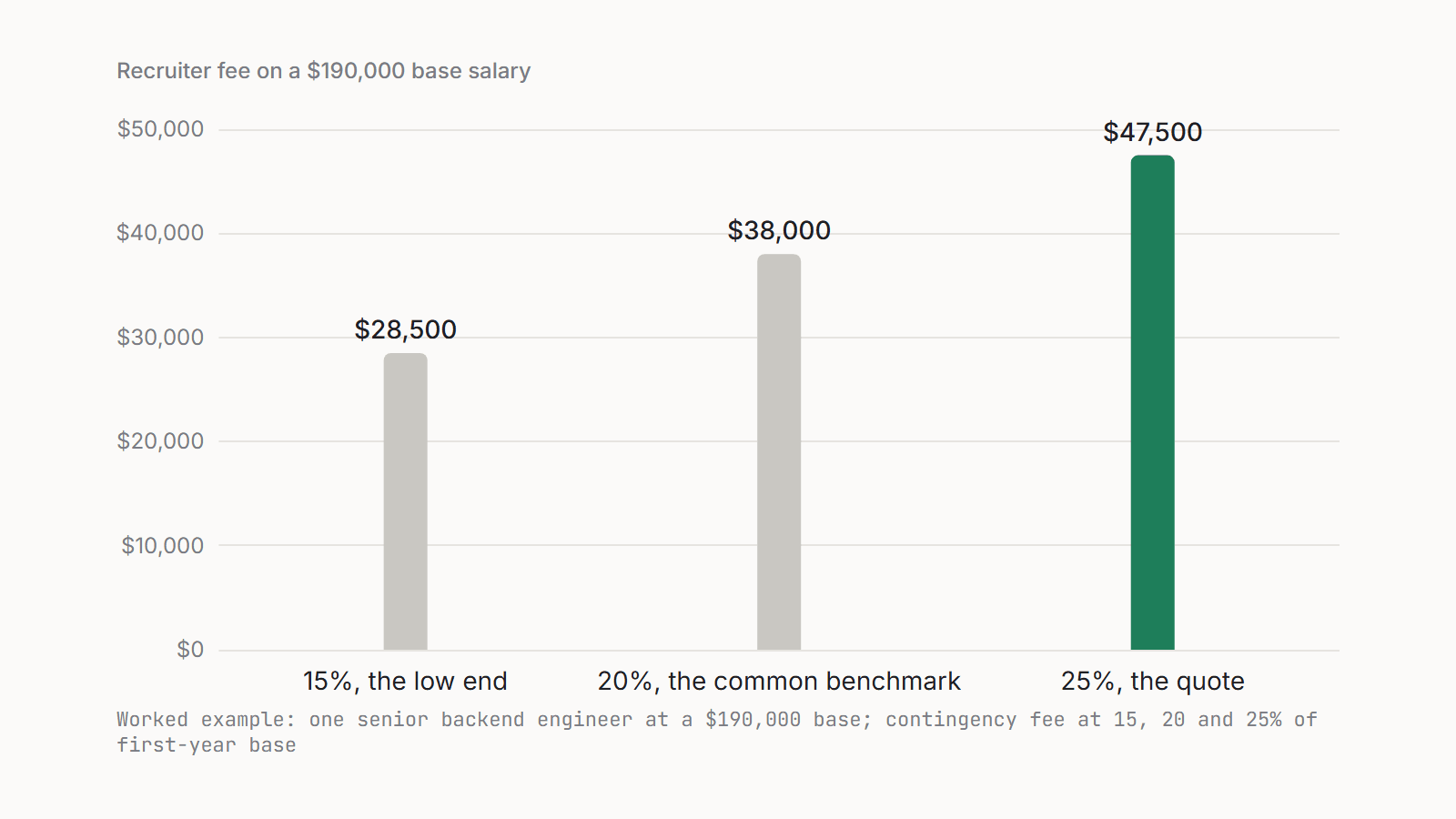
Between 15 and 25% of first-year base. Pin's freelance recruiter guide puts the most common fees at 20 to 22.5% inside that range and tells new independents never to quote below 18%. Chosen's publish wizard suggests 20% and says most roles land between 15 and 25%. On a $175,000 base, 20% is $35,000, owed when the hire starts.
Sources
- Freelance Recruiter Guide: How to Earn $200K+ Annually, Pin. Accessed Sep 30, 2026
- Ghosting, ghost jobs and bots: Candidates reveal their top challenges in the Greenhouse 2024 State of Job Hunting report, Greenhouse. Accessed Sep 30, 2026
- What's happening to talent acquisition careers, 2026 edition, ERE. Accessed Sep 30, 2026
- Recruit on the Chosen marketplace, Chosen. Accessed Sep 30, 2026