When a startup needs its first in-house recruiter
At 12 hires a year and 20% fees, a fully loaded $130,000 recruiter breaks even at five fills, so hire by the hires you plan, not by headcount.
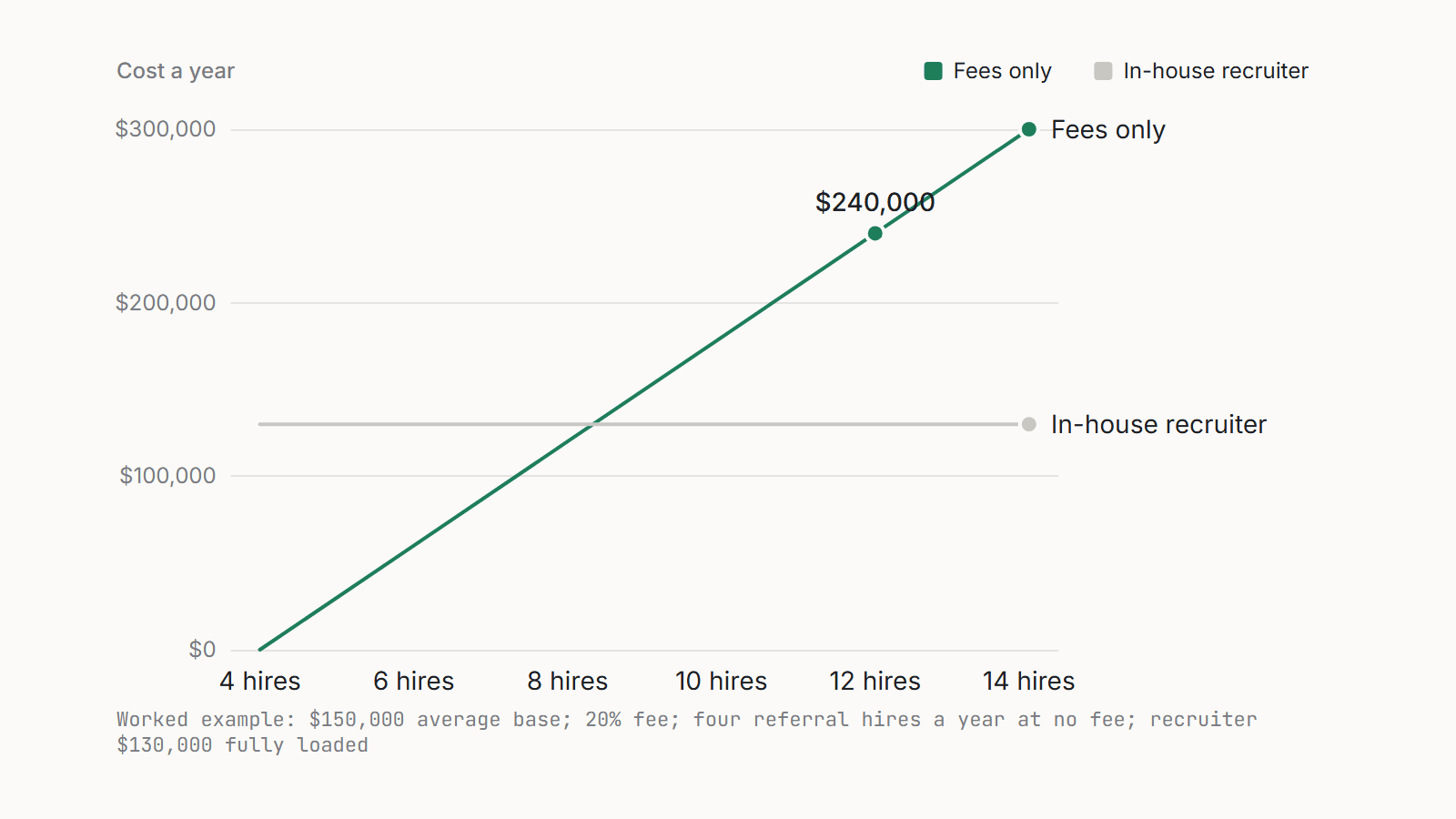
At 12 hires a year, now. A recruiter at $130,000 fully loaded is paid for by five fills that would otherwise carry a $30,000 fee each, and the crossover on the whole year sits near eight hires. Headcount never enters the math; 35 people is a coincidence. Start the search this quarter, because it takes one.
When a startup needs its first in-house recruiter
The honest answer is a count of hires, and you gave me the count: 12 this year. Here is the example I will run, and it is close to yours. Thirty-five people. Twelve hires in the next 12 months: five engineers, three in sales, two in product, a designer and someone in operations. An average base of $150,000 across them, which puts a 20% fee at $30,000 a hire. Four of the 12 will come from referrals and inbound whatever you do, and cost no fee either way. A recruiter at $110,000 base and about $130,000 fully loaded, with payroll taxes, benefits and tools.
That salary is not low. The BLS median for human resources specialists was $75,940 a year in May 2025, per the Occupational Outlook Handbook, and a startup recruiter who can close senior engineers and account executives sits well above the median. I would rather budget high and be pleasantly surprised.
On those numbers the recruiter breaks even at five fills, and the only question is whether five fills happen. At 12 hires with eight needing help, they do, with room to spare.
Headcount is the wrong trigger
The rule of thumb in most HR advice is to hire the first in-house recruiter at around 50 people, or once you are making 15 to 20 hires a year. The second half of that rule is closer to right than the first, and the first half is the one people remember. Headcount is easy to count, and it correlates with hiring, which is how it got into the rule. But the math of the decision never sees headcount. It sees hires in the next 12 months, the fee each would carry, and the recruiter's salary. A 35-person company hiring 12 crosses the line. A 60-person company hiring four does not, and it should keep buying fees.
There is a second cost the 50-person rule ignores, and in your case it is the biggest line: the founders are doing all the recruiting. Twelve hires at roughly 30 founder hours each, sourcing included, is about 360 hours a year. At $250 an hour, a conservative price on a founder's time at a funded company, that is $90,000 of founder time spent on work a recruiter does better. SHRM's benchmark, in a 2022 piece on the true cost of recruiting, had the average cost of a hire close to $4,700, and the same piece cites an estimate that about 60% of the real total is soft cost, meaning the hours of people already on payroll. Nobody invoices for founder time, so nobody counts it, and the rule of thumb waits for 50 people while the founders lose a day a week.
The break-even math at 12 hires a year
Two lines. The fee line is the hires that need outside help times $30,000. The recruiter line is $130,000 whether the recruiter fills two roles or twelve. With four referral hires a year at no fee, the fee line starts at the fifth hire.
| Hires a year | Fees only | In-house recruiter |
|---|---|---|
| 4 | $0 | $130,000 |
| 6 | $60,000 | $130,000 |
| 8 | $120,000 | $130,000 |
| 10 | $180,000 | $130,000 |
| 12 | $240,000 | $130,000 |
| 14 | $300,000 | $130,000 |
The lines cross a little past eight hires a year, where fees reach $130,000. That is 4.33 fee-carrying hires, so five. At your 12 the recruiter is $110,000 a year cheaper on fees alone, before a single founder hour is counted. At eight the recruiter is $10,000 more expensive on fees alone and about $34,000 cheaper once you count founder time: 22 of the 30 hours per hire move to the recruiter's desk, and eight hires at 22 hours and $250 is $44,000. At six, buy fees.
Two things the table hides. The recruiter will still send a hard role or two outside in a normal year, a staff engineer nobody in their network knows, and that adds $30,000 to 60,000 to the recruiter line and moves the crossover toward ten. And the $30,000 is an average: fees are set as a percent of first-year base and climb with the salary, so the year you hire a VP of Engineering at $250,000 the fee on that one role is $50,000 and the recruiter looks better than the table says.
The first year is a ramp, not a full year
The table is a steady-state year. Year one is not. The recruiter search runs on the same calendar as every other search: an accepted offer six to eight weeks out when it goes well, a notice period, then a month of learning your bar and building pipelines before the first candidate starts. Count nine productive months in the first year, and count the first placements landing a quarter after the recruiter does.
Run year one on the example. Ten months of a $130,000 loaded cost is about $110,000. The recruiter fills six of the eight fee-carrying hires instead of all eight, and you pay $60,000 in fees on the two they did not get to. That is $170,000 against $240,000 of fees only, so the recruiter still wins at 12 hires, by $70,000 instead of $110,000. Run the same year at eight hires and it is $110,000 in loaded cost, three of four filled and one $30,000 fee: $140,000 against $120,000, a $20,000 loss in year one that the founder hours cover and the fees alone never do.
So the ramp is the discount, and the discount is why I want the eight in the plan for two years running before I open the search. A one-year spike is a fees year.
What the recruiter does that a fee cannot buy
A fee buys a candidate. It does not buy a process. At 35 people the founders are running twelve loops with no scorecards, comp decided at offer time, and a candidate experience that depends on who remembered to reply. The six fills are the smaller half of what the recruiter produces in year one. The larger half is the loop that makes hire 13 cheaper than hire 12: a scorecard per role, a comp band before the first call, one owner for every candidate's next step, and a referral program with an owner.
The recruiter also sells. Nhat argued on this blog that the founding recruiter is the second salesperson at your startup and that most founders hire one later than they should; I agree, and until that person starts, Chosen adds capacity per role without adding a salary.
And the recruiter sees all twelve roles at once, where a fee sees one. When the same senior engineer fits both the platform role and the payments role, or the sales comp band is about to break the engineering band, the person who notices is the one who owns the whole plan. Supply is on your side too: ERE's 2026 report on talent acquisition careers puts the BLS count of human resources specialists 5,030 lower in 2025 than a year earlier, the first drop since the series began, so good recruiters are on the market and you are hiring into a soft year.
The rule of thumb at 35 people
Count the hires in the next 12 months, and the 12 after that. Eight or more in both years, open the search now, because it takes a quarter and the ramp takes another, and every month you wait is a month of fees and founder weekends. Four to seven, buy fees and keep the founders on the closing calls only. Under four, the founders do it, and it should not take a day a week.
At 35 people and 12 hires this year, you are past the line and have been for a while. While the search runs, put the roles due this quarter on pay-on-hire recruiters so the founders stop sourcing after midnight. When the recruiter starts, hand over those roles and the loop, and keep the founders on the close.
Write the 12 hires into a plan with start dates, and open the recruiter search this week.
Questions people ask next
Should I hire a recruiter, use an agency, or keep doing it myself?
It depends on the calendar. A recruiter takes about eight weeks to hire and a month to ramp, so hires due this quarter come down to your own hours or a fee paid at each start. For next year's plan, eight or more hires means the recruiter search opens now, while fees carry the roles that cannot wait.
Is RPO overkill for a Series B hiring 30 people this year?
Usually. RPO is a rented hiring function billed monthly whether or not hires land. At 30 hires a year, two in-house recruiters plus pay-on-hire help on the hardest roles tend to cost less and leave the process in your hands. RPO fits when the 30 is a one-year spike you do not want to staff for.
How do I build a hiring plan for a Series A that needs 18 people in 12 months?
Start from start dates and work backwards eight to twelve weeks per role, staggered so no month has more than three loops running. Decide per role whether founders, the recruiter or a fee carries the sourcing. At 18 hires an in-house recruiter breaks even inside the first year, so that search opens first.
Sources
- Human resources specialists, Occupational Outlook Handbook, US Bureau of Labor Statistics. Accessed Sep 30, 2026
- The real costs of recruitment, SHRM. Accessed Sep 30, 2026
- What's happening to talent acquisition careers, 2026 edition, ERE. Accessed Sep 30, 2026